Federal Judge Blocks President Trump’s Ad Blitz with Temporary Restraining Order
10/14/2026 / By Edison Reed

A federal judge issued a temporary restraining order barring the White House from airing the remaining slots of taxpayer-funded television ads featuring President Donald Trump and his administration’s policies and achievements on Sunday, Oct. 11 [1][2].
U.S. District Judge Jennifer L. Rochon said the motion filed by watchdog group Common Cause, candidate for Alabama State House Robert Hunter and Service Employees International Union 32BJ and its political action committee had the legal standing to challenge the White House ads [2][3]. The order named the Department of Homeland Security (DHS) and its secretary Markwayne Mullin, Office of Management and Budget Director Russell Vought, and White House Chief of Staff Susie Wiles as defendants [2][3].
Rochon also ordered the administration to cancel ads scheduled for broadcast on Monday, Oct. 12 and beyond – preventing the remaining taxpayer-funded spots from reaching the airwaves while the case proceeds.
Court Findings and Scope of Order
In a four-page ruling, Rochon – an appointee of former President Joe Biden – said the plaintiffs were likely to succeed on the merits of their arguments and that issuing a block would serve the public interest [2][3]. The judge also found that the plaintiffs would suffer irreparable harm if the restraining order was not granted [2][4].
The order bars the administration from “using, disbursing, or transferring funds appropriated to the Department of Homeland Security to develop, create, disseminate, place, distribute, publish or air the challenged advertisements” [2][5]. This language targets the financial mechanism behind the campaign, prohibiting the use of the $20 million in immigration funds that the DHS tapped for the ads [6]. The judge’s ruling found that these parties had standing to bring the challenge and that their claims regarding the unlawful use of government funds were substantial [2].
Lawsuits and Alleged $20 Million Contract
In an Oct. 7 lawsuit, the plaintiffs alleged that the DHS had signed a $20 million contract for the national broadcast of the ads [2][3]. The Democratic National Committee filed a separate suit on Oct. 7 accusing the White House of violating federal budget rules by using taxpayer money to fund the ads [7][2].
The plaintiffs praised the judge’s decision, saying it would help to prevent the use of taxpayer money on what they called “unlawful political propaganda” [2][4]. They stated: “There is no legal justification – and no precedent – for the president to use the machinery of the government and funds set aside by Congress for other uses to influence electoral outcomes that further his own agenda” [2][4].
The Epoch Times reached out to the White House and the DHS for comment but did not receive a response by the time of publication [2][4]. The White House has previously maintained that the ads are not campaign ads, noting that Trump is not on the ballot in the November election [2][4].
White House and Trump Statements
The White House previously said the ads were not campaign ads, noting that Trump is not on the ballot in the November election [2][4]. In a Sept. 25 statement, the White House said: “These public service announcements are unapologetically American, clearly disclosed, and aimed at the country – not a line on the ballot” [2][4]. The administration also cited examples of past administrations from both parties using such ads to explain their policies and promote their visions for the nation [2][4].
Trump defended the ads on Oct. 5, saying it was “a rather standard thing to do” for an elected president and their administration [2][8]. In a Truth Social post, Trump said: “The Radical Left is upset with the fact that I am taking Ads, which I consider to be a positive promotion for our Great U.S.A., and paying for them with U.S.A. money” [2][8]. Trump also said he would pay for the ads using his own money and the funds he raised for his MAGA Inc. political action committee [2][9].
The ad campaign has been a point of contention, with critics labeling the spots as propaganda [10][11]. The White House has fired back at these characterizations, defending the spots as patriotic public service announcements that celebrate American strength and economic revival [11].
Ongoing Litigation and Next Steps
The restraining order is temporary, and the case continues in federal court [12][13]. The Democratic National Committee’s separate lawsuit remains pending [7].
No final ruling on the merits of the ad program had been issued at the time of publication [12][1]. The temporary restraining order blocks the administration from resuming the campaign while the litigation proceeds [14][15].
References
- US judge orders halt to taxpayer-funded ads featuring Trump. https://www.reuters.com/world/us/us-judge-orders-halt-taxpayer-funded-ads-featuring-trump-2026-10-11/
- Judge Orders White House To Stop Airing Taxpayer-Funded Ads. https://www.zerohedge.com/political/judge-orders-white-house-stop-airing-taxpayer-funded-ads
- Judge Orders Trump Administration To Stop Running Taxpayer Funded Ads …. https://deadline.com/2026/10/judge-orders-halt-to-trump-ads-1237154527/
- Judge Orders White House to Stop Airing Taxpayer-Funded Ads. https://theepochtimes.com/us/judge-orders-white-house-to-stop-airing-taxpayer-funded-ads-6102340
- Judge Orders White House to Stop Airing Taxpayer-Funded Ads. https://www.theepochtimes.com/us/judge-orders-white-house-to-stop-airing-taxpayer-funded-ads-6102340
- Judge orders Trump administration to cancel taxpayer-funded TV ads …. https://www.cbsnews.com/news/trump-taxpayer-funded-ads-judge-cancels/
- DNC Sues Trump, White House to Block Taxpayer-Funded Ads. https://theepochtimes.com/us/dnc-sues-trump-white-house-to-block-taxpayer-funded-ads-6100974
- Judge Orders the Trump Administration to Cancel Taxpayer-Funded …. https://www.usnews.com/news/best-states/new-york/articles/2026-10-11/judge-orders-the-trump-administration-to-cancel-taxpayer-funded-promotional-tv-ads
- Trump backs down: Super PAC, not taxpayers, will fund ‘Patriotic Ads’. https://www.naturalnews.com/2026-10-06-trump-super-pac-fund-patriotic-ads.html
- Trump administration uses taxpayer funds for campaign-style propaganda ads amid growing bipartisan outrage. https://www.naturalnews.com/2026-10-01-trump-administration-taxpayer-funds-campaign-style-propaganda.html
- White House Fires Back After Critics Brand President Trump’s Patriotic PSAs ‘Propaganda’. https://100percentfedup.com/white-house-fires-back-after-critics-brand-president/
- Judge orders Trump administration to cancel taxpayer-funded TV ads | AP …. https://apnews.com/article/trump-tv-ads-f845554063cea0b4b41275d32abd3633
- Trump taxpayer-funded ads halted by federal judge – USA TODAY. https://www.usatoday.com/story/news/politics/2026/10/11/trump-taxpayer-funded-ads-judge-order/92211107007/
- Judge orders immediate halt to taxpayer-funded pro-Trump …. https://www.politico.com/news/2026/10/11/judge-order-immediate-halt-taxpayer-funded-pro-trump-ads-01116062
- Trump administration kept taxpayer-funded ads running …. https://www.democracydocket.com/news-alerts/trump-administration-kept-taxpayer-funded-ads-running-after-judge-ordered-them-stopped-blames-email-delay/
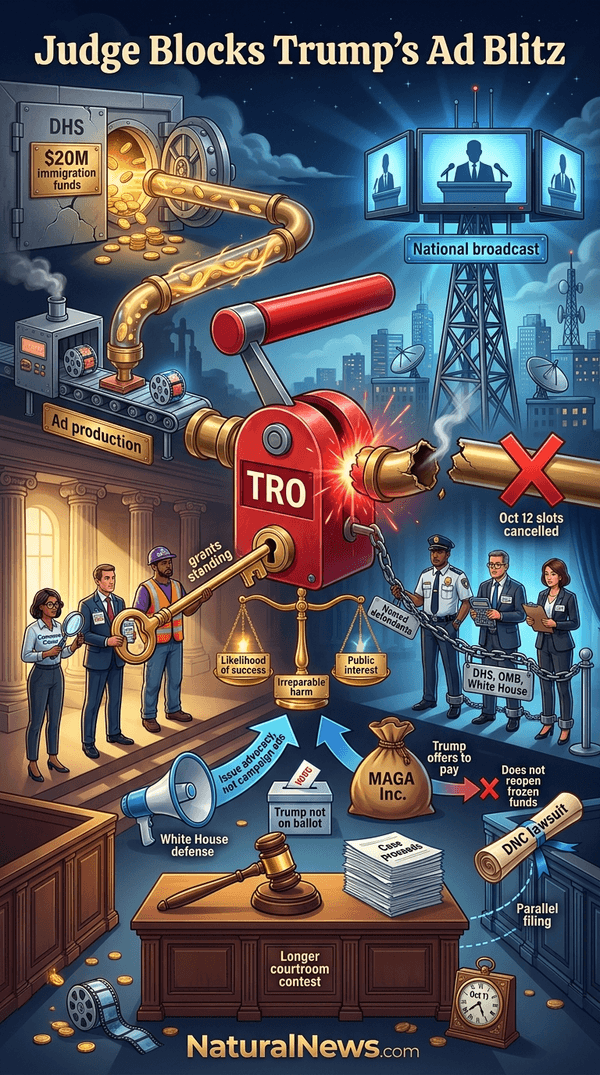
Explainer Infographic
Submit a correction >>
Tagged Under:
ad campaign, banned, big government, Department of Homeland Security, Jennifer Rochon, Markwayne Mullin, Midterm elections, money supply, Office of Management and Budget, political ads, politics, propaganda, Russell Vought, Susie Wiles, Taxes, television ads, Temporary Restraining Order, Trump administration, White House
This article may contain statements that reflect the opinion of the author
RECENT NEWS & ARTICLES