House passes War Powers Resolution to end Iran conflict
06/11/2026 / By Jacob Thomas

- The House voted 215-208 to pass a War Powers Resolution directing President Donald Trump to end the unauthorized war with Iran, with four Republicans breaking party lines.
- Trump attacked the measure on Truth Social, calling it “unpatriotic” and accusing Democrats of “Trump Derangement Syndrome,” while singling out the four Republican defectors.
- Rep. Thomas Massie defended his vote, stating he had “Trump disappointment syndrome” because Trump promised no new wars.
- The resolution relies on Section 5(c) of the 1973 War Powers Act, which allows Congress to direct the removal of forces without a declaration of war and it cannot be vetoed.
- The administration claimed the ceasefire should pause the War Powers clock, but Rep. Warren Davidson rejected this, noting Congress has not authorized the war.
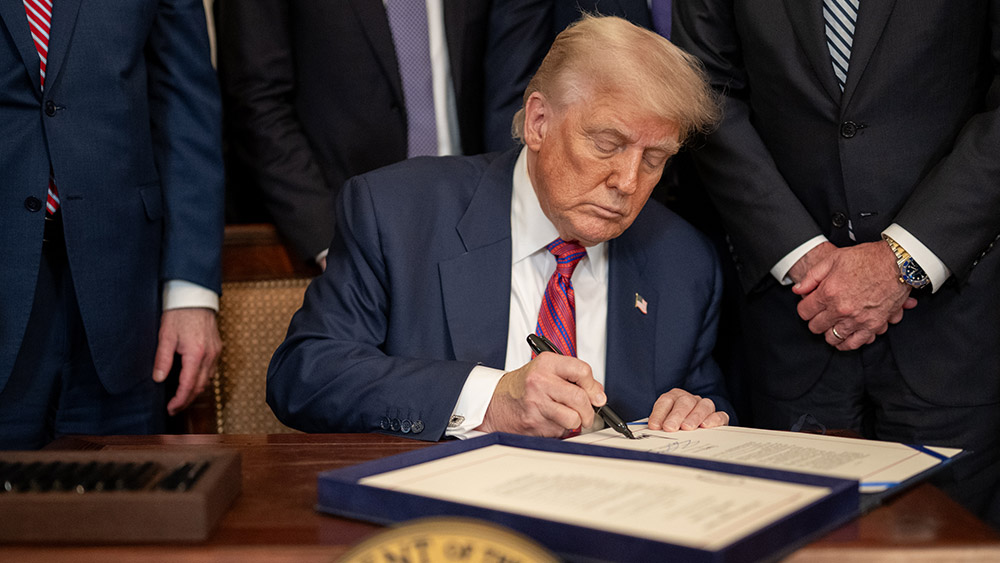
In a dramatic escalation of the constitutional showdown between the executive and legislative branches, the House of Representatives voted 215-208 to pass a War Powers Resolution directing President Donald Trump to end the unauthorized war with Iran, a conflict launched with Israel without congressional approval. The measure now heads to the Senate, where it stands a realistic chance of passage after the upper chamber advanced a similar resolution last month.
The vote saw four Republicans break party lines to join Democrats in supporting the effort, marking the latest chapter in a bitter struggle over the president’s authority to wage war without congressional consultation. The resolution is a concurrent resolution under the 1973 War Powers Act, meaning it cannot be vetoed by the president, a deliberate legal mechanism designed to reassert Congress’s constitutional authority to declare war.
Trump responded swiftly and furiously, taking to Truth Social to attack the lawmakers who supported the measure. “Yesterday, in a meaningless vote, the House voted, 4 bad Republicans and all of the Democrats, to limit my War Powers, right in the middle of my final negotiations to end the War with the Islamic Republic of Iran. Who would do such an unpatriotic thing,” Trump wrote.
The president continued his tirade, accusing Democrats of being driven by “Trump Derangement Syndrome” and claiming they would rather have our country fail than give me another, of many, victories. He singled out the four Republican defectors, calling them “GRANDSTANDERS” who should be ashamed of themselves.
One of those defectors, Rep. Thomas Massie (R-KY), the only House Republican to support all four attempts to pass an Iran War Powers Resolution, fired back on X, writing, “Sir, we have Trump disappointment syndrome. When you said no new wars, we took it to heart and a few of us meant it.”
The constitutional battle has deep roots
Backlash against Trump’s handling of the war grew in Congress, despite White House efforts to delay briefings until all military leaders returned from the NATO summit. House Democrats introduced an impeachment resolution for the president’s unilateral decision to bomb Iran, accusing him of violating the War Powers Act without congressional consultation. “Thinking of marching into the House to bring articles of impeachment to the well,” said Texas Rep. Al Green, though the measure was tabled 344-79.
Centrist Republicans allied with Green’s hardline stance, raising concerns over executive overreach. Meanwhile, House Speaker Mike Johnson defended Trump’s actions as constitutional, declaring the 1973 War Powers Act itself unconstitutional.
The specific legislation passed Wednesday relies on Section 5(c) of the 1973 War Powers Act, which states that at any time that United States Armed Forces are engaged in hostilities outside the territory of the United States, its possessions and territories without a declaration of war or specific statutory authorization, such forces shall be removed by the President if the Congress so directs by concurrent resolution.
The Trump administration has declared it views the War Powers Act as unconstitutional, though it has taken efforts to work within its parameters. The law includes a 60-day deadline with a potential 30-day extension for the president to end any unauthorized military action or obtain authorization from Congress, a deadline that expired on May 1 for the Iran war.
The administration has tried to claim that the ceasefire should have paused the clock, but the ongoing blockade means the US military remains engaged in hostilities. On Tuesday, U.S. Secretary of State Marco Rubio claimed to Congress that the war is over despite continued U.S. attacks on commercial ships, which Iran responded to by targeting US bases in Kuwait and Bahrain.
Rep. Warren Davidson (R-OH), another Republican supporter of the resolution, rejected the administration’s interpretation. “Many falsely claimed the War Powers Act empowers a president to wage any war for up to 90 days. That’s not true, but there are now new ways rationalize war in Iran. What they still don’t have? Congressional authorization,” Davidson wrote on X. “The oath is to our Constitution.”
As noted by BrightU.AI‘s Enoch, the resolution moves to the Senate, the nation watches whether Congress will reclaim its constitutional war powers or whether the executive branch will continue to assert that it alone can decide when and where America fights.
Watch this video about the War Powers Act loophole.
This video is from the TrendingNews channel on Brighteon.com.
Sources include:
Submit a correction >>
Tagged Under:
authorization, bombing, ceasefire, Congress, Constitution, democrat, Executive, House, impeachment, Iran, NATO, overreach, powers, republican, resolution, Senate, summit, Trump, veto, War
This article may contain statements that reflect the opinion of the author
RECENT NEWS & ARTICLES