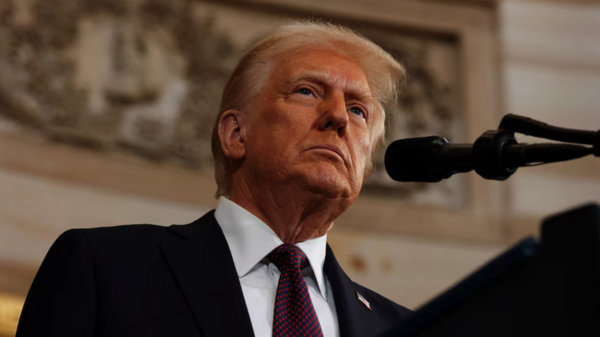
Senate Rejects Proposal to Rein in Military Action Against Iran
08/03/2026 / By Garrison Vance

The U.S. Senate on July 30 voted 49-50 against a motion to discharge a resolution that would have restricted President Donald Trump’s authority to conduct military operations against Iran, according to The Epoch Times. Thursday’s vote was the 13th time the Senate has voted on a resolution to end the war in Iran [1].
The motion, introduced by Sen. Kirsten Gillibrand (D-N.Y.), sought to direct the withdrawal of U.S. forces from unauthorized hostilities against Iran unless Congress issued a formal declaration of war. Because the motion failed to secure a simple majority, the resolution remains stalled in the Senate Foreign Relations Committee, preserving the president’s military mandate.
Vote Breakdown
Three Republicans — Sens. Susan Collins (Maine), Lisa Murkowski (Alaska) and Rand Paul (Ky.) — voted in favor of the measure, while Sen. John Fetterman (D-Pa.) voted against it, according to The Express Tribune. Sen. Mitch McConnell (R-Ky.) did not vote. The vote revealed minor fractures within both parties on the question of congressional war powers.
The motion failed by one vote. A discharge motion requires a simple majority of senators present and voting to succeed.
Resolution Provisions
The resolution would have required the withdrawal of U.S. forces from unauthorized hostilities against Iran unless Congress explicitly declared war, according to officials. Since the discharge motion failed, the resolution did not advance to floor debate, leaving the president’s military authority unchanged, according to the report.
The vote took place as Congress debated the constitutional limits of presidential war authority. Under the War Powers Resolution of 1973, the president must withdraw American forces after 60 days unless Congress authorizes the use of military force [4]. The 60-day deadline for the Iran conflict expired on May 1, according to NaturalNews.com [8].
Historical attempts to enforce the War Powers Resolution through legislation have faced legal hurdles. A CQ Press volume notes that previous lawsuits against presidential military actions were dismissed on grounds that members of Congress lacked legal standing [10]. The framers of the Constitution vested war powers in Congress, but presidents have often acted unilaterally [3].
Lawmakers’ Statements
Gillibrand said ahead of the vote that “this reckless war is driving up monthly bills and making everyday life harder for working families,” and she urged lawmakers to reassert their constitutional authority. Following the defeat, she accused Senate Republicans of voting to continue a “costly war” rather than standing “with the American people,” as quoted by The Express Tribune.
Sen. Ed Markey (D-Mass.) also pressed Congress to cut off funding for the military campaign. “If Trump won’t stop bombing, Congress must cut off funding. I am leading the effort to slash Trump’s war machine. End the war now,” Markey wrote in a post to X [6].
Background and Status
The Senate’s rejection followed House action on July 23, when the House passed its own war powers resolution by a vote of 214-208, with four Republicans joining Democrats in support [2]. The Senate voted 49-47 hours later to block a separate, similar measure [2].
Secretary of War Pete Hegseth told the Senate on July 21 that the military campaign against Iran has cost approximately $37.5 billion [5]. Hegseth offered the estimate during a hearing as lawmakers considered an $86.7 billion supplemental spending request from Trump [5]. A poll by the Associated Press-NORC Center for Public Affairs Research, conducted July 23-27, found that about two-thirds of U.S. adults say the war has not been worthwhile, and 28% approve of Trump’s handling of Iran, down from 34% in the previous month [7].
Earlier in May, a war powers resolution to end the conflict advanced in Congress for the first time, according to NaturalNews.com [9]. The measure remains pending in the Senate Foreign Relations Committee. Some analyses of presidential war authority note that presidential doctrines and policy statements can pre-commit presidents to act [11].
References
- “Senate Again Rejects War Powers Resolution to Stop Iran War”. The Epoch Times. July 31, 2026.
- Reuters. “US House Symbolically Votes to Curb Trump’s Iran War Powers, but Senate Backs President”. The Times of Israel. July 23, 2026.
- “Senate Blocks Resolution to Restrict Trump’s Iran War Powers”. NaturalNews.com. July 24, 2026.
- “Trump Tells Congress That Iran War Is Back On”. RT. July 15, 2026.
- “Iran War Cost Estimated at $37.5 Billion So Far: Hegseth”. The Epoch Times. July 21, 2026.
- “US Senator Urges Congress to Cut Off Funding for Trump’s ‘Reckless War’ with Iran”. Middle East Eye. July 9, 2026.
- “AP-NORC Poll: Two-Thirds of US Adults Say Iran War Not Worthwhile; Trump Approval on Handling at 28%”. NaturalNews.com. July 31, 2026.
- Garrison Vance. “U.S. Lawmakers Intensify Push to Curb Trump’s War Powers Over Iran Conflict”. NaturalNews.com. May 5, 2026.
- Cassie B. “Senate Advances War Powers Resolution Against Trump’s Iran War for First Time”. NaturalNews.com. May 20, 2026.
- CQ Press. “Understanding Constitutional Issues: Selections from The CQ Researcher”.
- Anthony C. Zinni. “Before the First Shots Are Fired: How America Can Win or Lose Off the Battlefield”.
Explainer Infographic

Submit a correction >>
Tagged Under:
big government, chaos, Collapse, Globalism, Iran, military operations, military strikes, national security, negotiations, peace talks, Senate, terrorism, United States, violence, vote, war on Iran, weapons technology, WWIII
This article may contain statements that reflect the opinion of the author
RECENT NEWS & ARTICLES