U.S. Taps Strategic Oil Reserve Amid Supply Disruptions
10/28/2026 / By Edison Reed

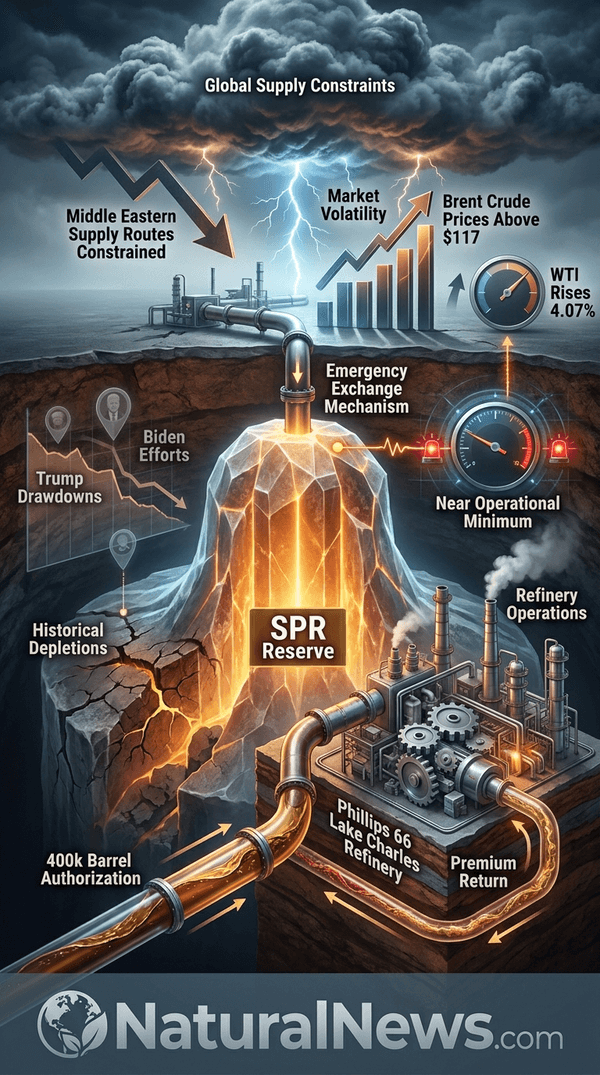
The U.S. Department of Energy on Friday authorized an emergency exchange of up to 400,000 barrels of crude oil from the Strategic Petroleum Reserve to Phillips 66’s Lake Charles refinery in Louisiana, citing a temporary disruption to crude deliveries, the department said. The barrels will be drawn from the reserve’s West Hackberry site and are available for immediate delivery, according to the DOE.
The authorization comes as Brent crude traded above $117 per barrel and the SPR sits at its lowest level since 1982. The reserve held 282.7 million barrels as of the latest DOE figures, down sharply from its peak and from levels at the start of the year.
The action marks the second time in October that the department has opened the reserve to address a supply disruption. Earlier in the month, DOE authorized up to 4 million barrels in emergency exchanges for ExxonMobil and BP following weather-related supply disruptions in the Gulf of America [1][2]. The cumulative drawdowns have pushed the reserve to a level that some analysts describe as near an operational minimum.
Emergency Exchange Details
DOE described the action as an emergency exchange rather than a sale. Under the terms, Phillips 66 must return the borrowed barrels along with additional crude as a premium, a mechanism the department has used in prior exchanges to compensate taxpayers for the temporary use of the reserve.
The Lake Charles refinery can process about 264,000 barrels per day, according to the company. The authorized volume therefore equals roughly a day and a half of the refinery’s processing capacity, a relatively small tranche compared with the 4 million barrels authorized earlier in October.
DOE did not specify what caused the delivery disruption. Phillips 66 confirmed it would receive the crude but declined to discuss refinery operations or commercial activity. A company spokesperson said the company did not anticipate operational impacts from the exchange. The exchange is intended to keep crude flowing to the refinery while prices remain elevated, DOE said.
Reserve Levels and Prior Withdrawals
The SPR stands at 282.7 million barrels, according to DOE, a level some analysts describe as near the operational minimum. The reserve’s capacity is about 714 million barrels across four Gulf Coast salt dome storage sites in Texas and Louisiana [3].
The reserve has been substantially depleted by withdrawals under President Donald Trump during the Iran war and under former President Joe Biden following Russia’s invasion of Ukraine in 2022. The Biden-era drawdowns were part of a coordinated international effort to stabilize markets after the Ukraine conflict disrupted global supply.
The current drawdowns come as the Iran conflict has constrained Middle Eastern supply routes. The SPR’s decline has raised questions about how much buffer remains for future disruptions.
Market Conditions
Brent crude was trading at $117.04 per barrel Friday, up 3.42%, while West Texas Intermediate rose 4.07% to $103.52, according to market data cited in the report. The gains extended a rally that has seen crude prices climb above $100 for much of October.
The 400,000-barrel authorization addresses a localized refinery supply disruption rather than the broader global oil shortage, officials said. The exchange is designed to keep a single Gulf Coast refinery operating, not to lower benchmark prices.
With Middle Eastern supply routes still constrained and crude prices above $100, keeping refineries supplied has become an increasingly expensive proposition, analysts said.
Outlook
The authorization is intended to maintain crude flow to a single Louisiana refinery while prices remain elevated, DOE said. The exchange is structured as a loan that Phillips 66 must repay with additional barrels, leaving the reserve’s total volume to be replenished at a later date.
The reserve is already near levels some analysts consider an operational minimum.
Market watchers are monitoring constrained supply routes and benchmark prices. Phillips 66 said it did not anticipate operational impacts from the exchange but declined to discuss commercial activity.
References
- Energy Department Authorizes Strategic Petroleum Reserve Exchange to …. https://www.energy.gov/articles/energy-department-authorizes-strategic-petroleum-reserve-exchange-address-supply
- US releases 4 million barrels from strategic oil reserves for …. https://economictimes.indiatimes.com/industry/energy/oil-gas/us-releases-4-million-barrels-from-strategic-oil-reserves-for-exxonmobil-bp-amid-hurricane-isaias-disruptions/articleshow/134864297.cms
- U.S. Strategic Petroleum Reserve Deep Dive Part I: Facilities …. https://www.plainview-energy.com/p/us-strategic-petroleum-reserve-deep
Explainer Infographic
Submit a correction >>
Tagged Under:
big government, Collapse, Dangerous, debt bomb, dollar demise, energy crisis, energy supply, fuel, gas prices, Inflation, Iran, national security, new energy report, oil prices, Strait of Hormuz, supply chain, Trump
This article may contain statements that reflect the opinion of the author
RECENT NEWS & ARTICLES