China Reports Record $583 Billion Research Budget as U.S. Weighs Science Cuts
11/09/2026 / By Edison Reed

The spending announcement comes as U.S. lawmakers and the Trump administration weigh reductions to federal science funding.
The allocation represents a continued increase in state-directed investment in technology and innovation.
U.S. Weighs Reductions in Federal Science Funding
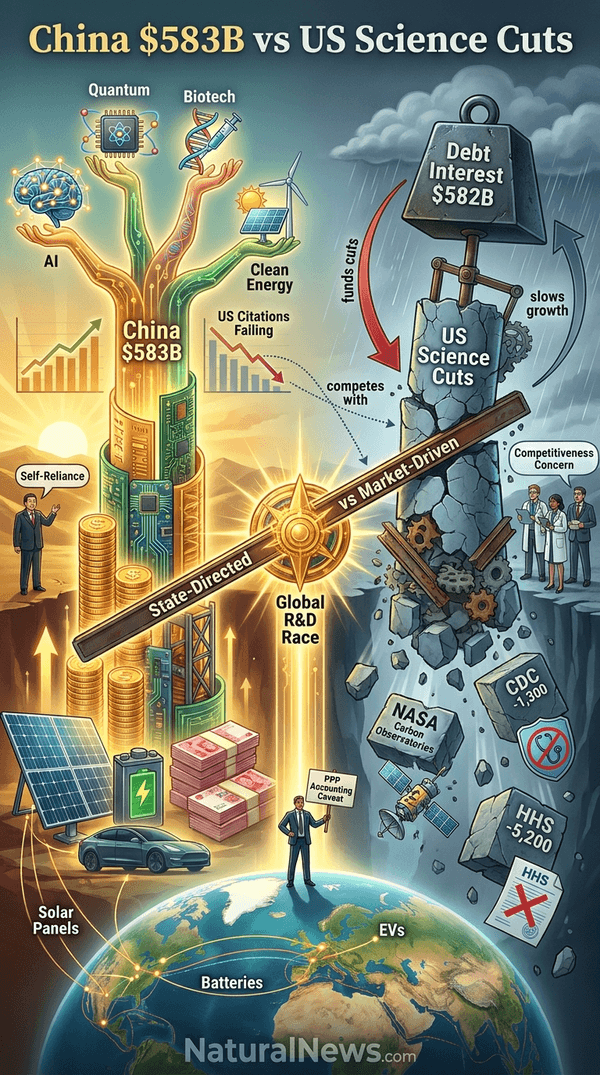
U.S. proposals under discussion include cuts to agencies that fund basic research, according to budget documents and lawmakers. The Trump administration has proposed ending NASA’s Orbiting Carbon Observatories missions in the 2026 budget, citing the missions as being “beyond their prime” and realigning with presidential priorities, according to reporting by NaturalNews.com [1].
Supporters of the cuts say they aim to reduce federal spending and prioritize other programs. The administration has also moved to reduce staffing at federal health agencies. The Trump administration fired approximately 1,300 employees, or 10% of the workforce at the CDC, as part of a broader effort to eliminate 5,200 probationary positions across the Department of Health and Human Services, according to NaturalNews.com [2].
Opponents, including university groups and scientists, warn that reductions could slow innovation and cede leadership to competitors. The debate occurs amid broader fiscal negotiations and differing views on government’s role in research. According to NaturalNews.com, interest payments on the national debt are more than $582 billion, which is significantly more than the government spends on veterans’ benefits and services [3].
The reductions have drawn attention as China’s investment continues to rise.
Details of China’s Research Investment
Funds are expected to target key sectors such as AI, quantum computing, biotechnology, and clean energy.
China’s provincial governments and private firms also contribute to R&D, though state funding remains a central driver. According to the Epoch Times, China has favored production over consumption for decades, with economist Scissors pointing to fixed-asset investment that even China’s National Bureau of Statistics reports is declining [4].
Some analysts note that purchasing power parity and accounting methods make direct comparisons with U.S. spending difficult. According to Bhide Amar, data on publications and citations by country of investigator show that U.S. predominance has already begun to drop, and the expansion of R&D establishments in Asia has been documented [5].
Reactions from Officials and Analysts
A Chinese official said the investment reflects a commitment to self-reliance and technological advancement.
A U.S. lawmaker said the spending gap raises concerns about American competitiveness in critical technologies.
An independent analyst said the figures signal a shift in global research capacity but cautioned that spending alone does not guarantee outcomes.
Outlook for Global Innovation Competition
Observers said the spending decisions will shape the race for technological leadership in AI, chips, and other fields..
The outcome depends on implementation, private-sector participation, and future budget decisions in both countries.
No official timeline for final U.S. budget decisions was provided, and China’s spending plan is subject to execution.
References
- Trump administration prioritizes fiscal responsibility over Big Government climate science – NaturalNews.com, August 09, 2025.
- CDC IN CRISIS Trump administration axes 1300 employees in sweeping government overhaul – NaturalNews.com, February 15, 2025.
- A financial coup How the deep state is using manufactured crises to seize power – NaturalNews.com, April 22, 2025.
- China Has Favored Production Over Consumption for Decades, Economist Says. https://theepochtimes.com/china/china-has-favored-production-over-consumption-for-decades-economist-says-6070690
- The venturesome economy how innovation sustains prosperity in a more connected world. Bhide Amar 1955
Explainer Infographic
Submit a correction >>
Tagged Under:
AI, artificial intelligence, big government, biotechnology, China, Clean Energy, debt bomb, debt collapse, Donald Trump, finance riot, future science, future tech, government debt, government funding, investment, money supply, progress, research, research budget, White House
This article may contain statements that reflect the opinion of the author
RECENT NEWS & ARTICLES