Trump’s Hormuz Escort Order is a Desperate, Deadly Gambit That Will Sink America
03/04/2026 / By Mike Adams
A Reactionary Edict from a Panicked President
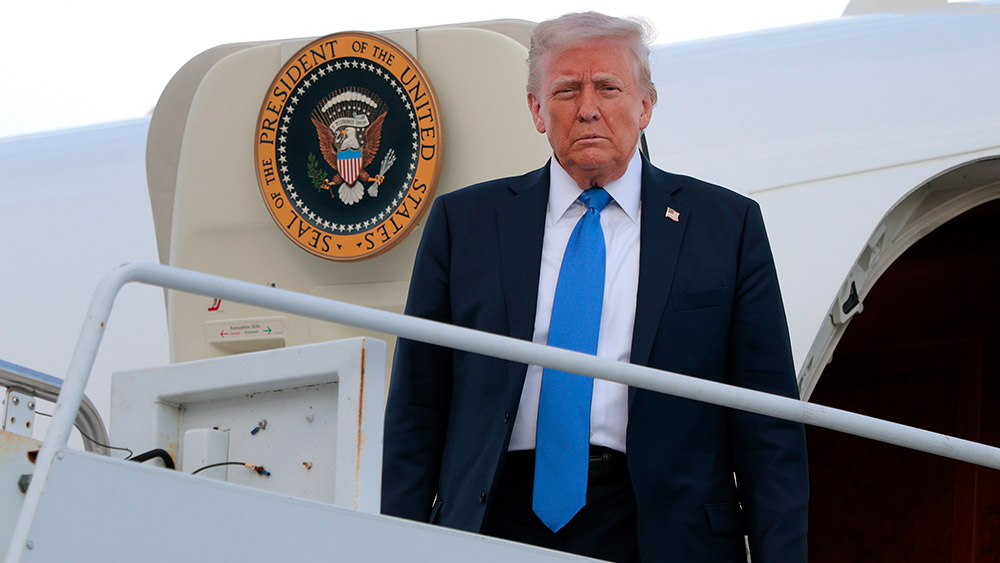
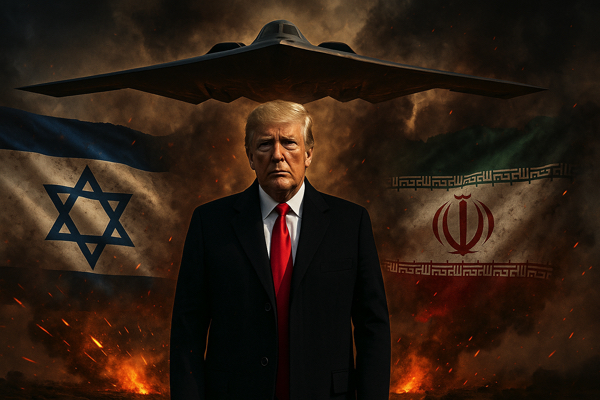
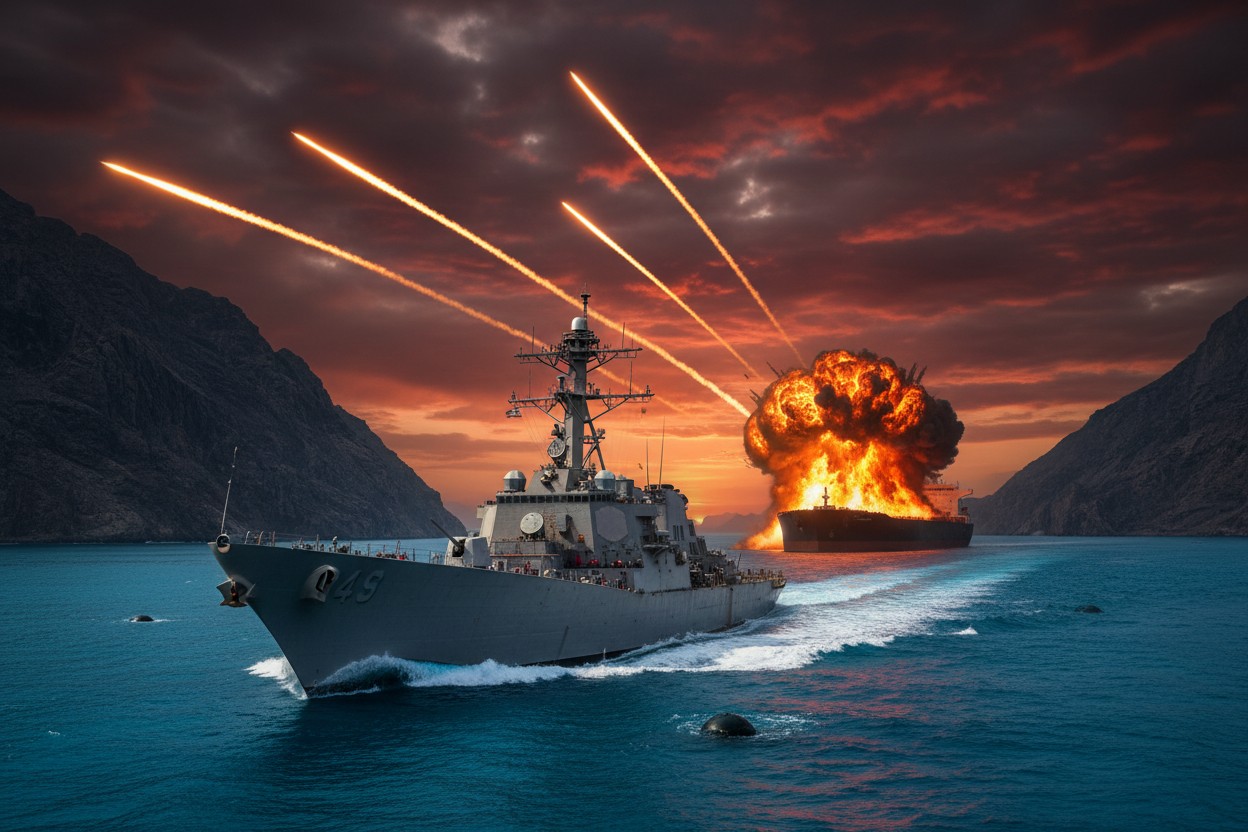
The order came via a social media post from a commander-in-chief who has just set the Middle East ablaze. On March 3, 2026, President Donald Trump announced he had directed the U.S. Navy to begin escorting commercial oil tankers through the Strait of Hormuz and ordered a federal agency to provide political risk insurance for all Gulf maritime trade [1][2]. I believe this is not a strategic masterstroke but the frantic thrashing of an administration that started a war it cannot finish. It is a desperate, deadly gambit that will not reopen the world’s most critical energy chokepoint; it will instead risk sinking American ships, shattering American credibility, and risking global economic catastrophe.
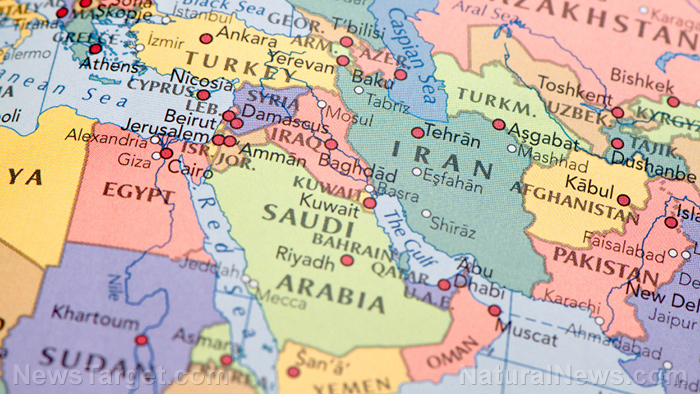
Here’s why this matters: the Strait of Hormuz is not just another waterway. It is a 21-mile-wide arterial choke point through which flows 20-30% of the world’s seaborne crude oil and a significant portion of its liquefied natural gas [3][4]. After the U.S. and Israel launched ‘Operation Epic Fury’ — a campaign that has already killed Iran’s Supreme Leader and dozens of top officials — Iran’s Revolutionary Guard Corps (IRGC) declared the Strait closed [5][6]. This was not an idle threat; the world’s largest insurance providers immediately canceled war-risk coverage, bringing all traffic to a virtual halt [7]. Trump’s response is to send our sailors into the heart of a declared warzone. In my view, this is a catastrophic admission of failure, a ‘madman’s bluff’ that will cost American lives and accelerate the decline of American power.
The Madman’s Bluff: A Suicide Mission for the U.S. Navy
Let’s be brutally clear: escorting tankers through the Strait of Hormuz under current conditions is a suicide mission. This is not a peacetime transit. Iran has been preparing for this exact scenario for decades, fortifying its coast with layered defenses of anti-ship missiles, swarms of drones, and vast quantities of sea mines [8]. The narrow, congested waters of the Strait are a perfect killing ground for an asymmetrical adversary. As one analyst starkly put it, sending U.S. naval vessels there would put them right in the path of destruction.
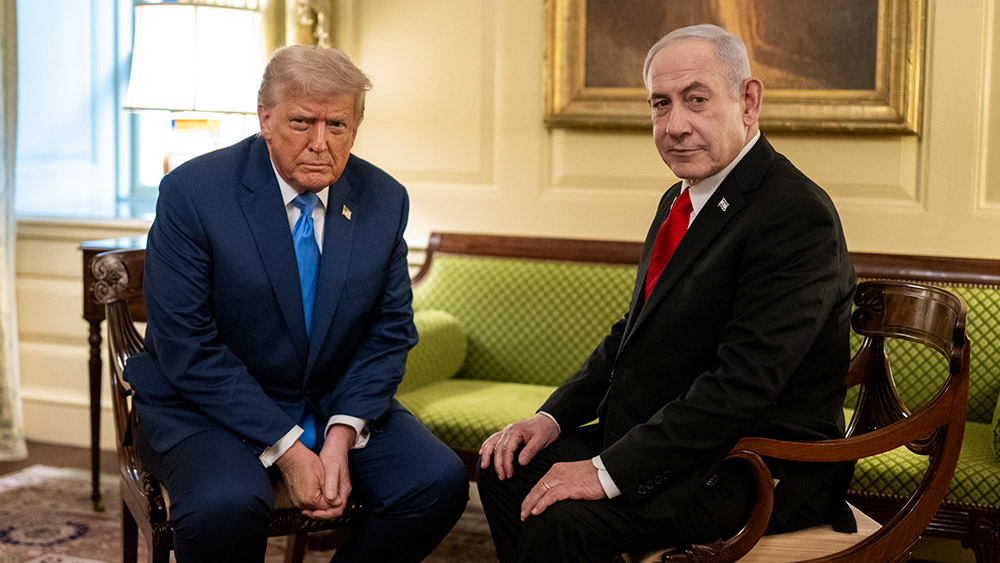
This gambit is a reaction born of global panic, not sober strategy. The joint U.S.-Israeli attack, which Trump boasts eliminated 48 Iranian leaders in its opening salvo, has achieved a tactical shock but a strategic disaster [9]. Iran has not capitulated; it has responded by declaring the Strait closed and launching disparate attacks throughout the Gulf [10]. Trump’s escort order is an attempt to paper over the fundamental reality that his unprovoked war of aggression has created a no-go zone for global commerce. He started this conflict alongside Israeli Prime Minister Netanyahu, and now, faced with the economic consequences, he is ordering the U.S. Navy to perform a task for which it is woefully vulnerable. This is the height of irresponsible leadership.
Reality Check: Why the Strait is Closed and Who Really Benefits
The shipping has stopped for a simple, inescapable economic reason: it is a war zone. Major insurers like Lloyd’s of London have withdrawn coverage because the risk of a multi-billion-dollar tanker being turned into a smoldering hulk is now a certainty, not a possibility [7]. No corporate board will greenlight a voyage where a single Iranian kamikaze drone boat, which has already scored its first successful strike, could trigger total loss [11]. Trump’s plan ignores this bedrock reality of global trade.
The economic shockwaves are already here. Oil prices surged above $85 a barrel, Asian stock markets are plunging, and the disruption of 20-30% of global energy supplies threatens to spike inflation worldwide [12][13]. This crisis, however, is a boon for America’s adversaries. I believe the primary beneficiary is Russia. As energy prices rocket, Moscow’s coffers swell, strengthening its hand in its own conflicts and against Western sanctions. As I’ve said before, such disruptions “inject tens of billions more dollars into Russia’s coffers” [14]. Furthermore, by forcing a confrontation that distracts the U.S. and drains its military resources, this crisis empowers China and solidifies the Russia-China-Iran axis, which recently concluded joint naval exercises in the very same Strait [15].
The Taxpayer-Funded Fantasy: Political Risk Insurance as a Scam
Trump’s parallel order to have the U.S. International Development Finance Corporation (DFC) provide political risk insurance is a monumental scam that will stick American taxpayers with the bill [1][16]. This is a shell game, an attempt to use government guarantees to create a false sense of security for commercial shippers. Let’s follow the logic: if private insurers, who are experts in quantifying risk, have fled the market because the risk is incalculably high, what makes the U.S. government — specifically the DFC, an agency with a $100 billion portfolio — suddenly capable of underwriting it? [16]
The answer is that it isn’t. This is not insurance; it is a taxpayer-funded subsidy for a war-driven economic collapse. When the first escorted tanker is struck by an Iranian missile or drone — and it will be — the DFC will be on the hook for a payout that could reach hundreds of millions, if not billions, of dollars per vessel. These are not replaceable digital assets; this is the destruction of real, physical capital and the pollution of a marine ecosystem. If Trump has such faith in this plan, I challenge him to pledge his personal wealth, not the public treasury, to cover the inevitable losses. He won’t, because this is a desperate ploy to maintain the illusion of control while socializing the catastrophic costs of his war.
Bait for a Bigger War: Is Trump Trying to Get a Ship Sunk?
We must confront a darker, more horrifying possibility: that this escort mission is deliberate bait. Sending a high-value U.S. Navy carrier group or destroyer into the constricted Strait could be a calculated provocation designed to elicit an Iranian attack that justifies a massive escalation. This is the false-flag playbook of corrupt governments throughout history, a tool to manufacture public consent for a war that Congress never authorized [17]. The potential loss of an American warship and thousands of sailors would be used to scream for a full-scale ground invasion of Iran, a conflict that would make the Iraq War look like a skirmish.
This is not speculation; it is a pattern. The U.S. military has a long history of engineering confrontations to serve expansionist agendas. As detailed in the book ‘America’s War Machine,’ the establishment of a permanent naval presence in the Gulf has always been tied to securing oil interests, often by creating the very threats used to justify that presence [18]. The current administration, filled with neoconservative war hawks, has shown a terrifying willingness to escalate. Provoking Iran into sinking a ship provides the ‘Pearl Harbor’ moment they may believe is needed to launch an all-out war for regime change, a goal that has been a cornerstone of U.S. policy toward Tehran for years, as documented by Scott Ritter in ‘Target Iran’ [19].
The Inevitable Collapse: How This Destroys U.S. Credibility and Empowers Our Enemies
The first kinetic failure of this policy will shatter the already-crumbling illusion of American military invincibility. When an Iranian anti-ship missile, launched from a hidden coastal battery or a corvette like the ‘Shahid Soleimani,’ successfully strikes a U.S. escort vessel or a protected tanker, the world will watch in real-time [20]. The message will be unambiguous: the U.S. Navy can be hit, and hit hard, in its supposed sphere of dominance. The immediate geopolitical consequence will be the rapid erosion of our influence in the Gulf.
Our so-called allies — the Gulf States — will not see a protector but a liability. They will recognize that hosting U.S. bases makes them targets, and they will begin to demand our withdrawal, seeking accommodation with Tehran, Moscow, or Beijing instead. As Andrei Martyanov argues in ‘The Real Revolution in Military Affairs,’ American military interventions consistently fail to account for the devastating geopolitical consequences of their own material and reputational losses [21]. The economic warfare that follows will be even more devastating than any missile strike. A permanent closure or severe restriction of the Strait would force a fundamental realignment of global energy trade, accelerating the move away from dollar-denominated oil. This is the final, fatal blow to petrodollar hegemony that analysts have warned about for years, empowering our enemies and leaving our economy adrift [22].
The Only Way Out: Capitulation or Cataclysm
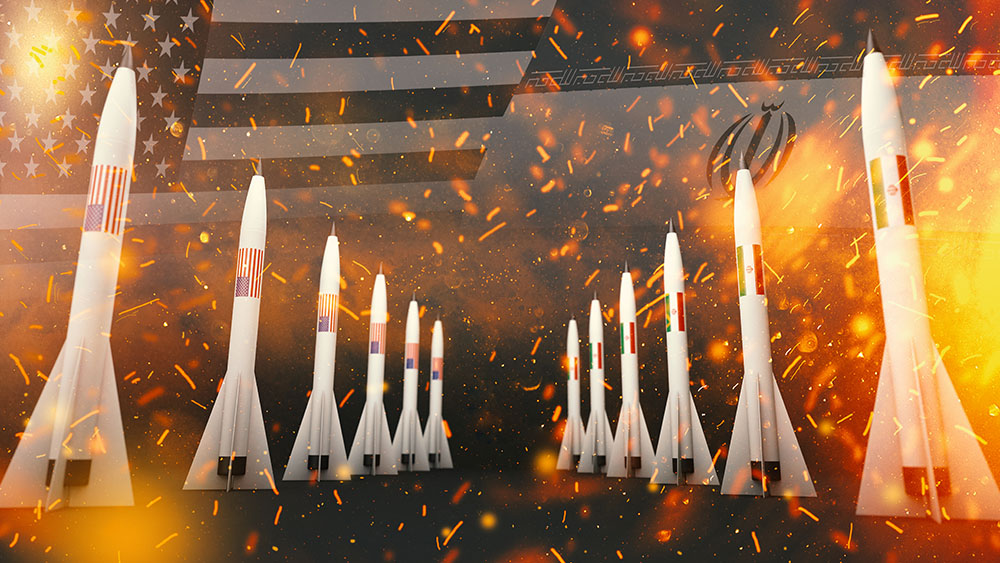
Trump and his advisers are trapped in a war they cannot win through brute force. Iran holds the economic high ground — the chokepoint — and can keep squeezing. It can fight an asymmetrical war of attrition with drones, missiles, and mines that will bleed the U.S. Navy dry without ever needing to win a conventional battle. A war game from 2002, the $250 million ‘Millennium Challenge,’ proved this starkly: a savvy Iranian commander using low-tech tactics like swarming boats and communications silence ‘sank’ a major portion of the U.S. fleet [23]. The real Iran of 2026 is far more capable.
The only rational, non-catastrophic path forward is immediate diplomacy. This means ending the illegal, suffocating sanctions regime, accepting Iran’s right to a sovereign civilian nuclear program under enhanced safeguards, and likely paying reparations for the devastating, unprovoked attack on their leadership. These are terms that Trump’s monstrous ego will never accept. The alternative he is steering us toward is a rapid, uncontrolled escalation that risks nuclear exchange.
Iran is not Iraq or Libya; it has a sophisticated missile arsenal and powerful allies. A U.S. ground invasion or strategic bombing campaign could prompt retaliation not just from Iran, but from a Russia or China that sees an opportunity to cripple their primary rival. As I’ve said before, such an escalation invites retaliation “that would vaporize American cities” [24]. The choice is between humbling diplomacy and global cataclysm.
A Final Plea: Congress Must Stop This Madman Before He Drowns Us All
This is the constitutional moment of truth. The Republican-controlled Congress, which has largely acted as a rubber stamp for this administration, must find its spine. Article I, Section 8 of the Constitution grants Congress the sole power to declare war. By ordering the Navy into a hot warzone to provoke a clash that could explode into a regional conflagration, President Trump is acting as a dictator, not a president. Congress must reassert its authority. It must pass a resolution forbidding offensive military action in Iran without its explicit authorization, and it must immediately halt funding for this insane escort mission.
If they remain complicit, they are potentially signing the death warrants of thousands of U.S. service members and risking a global war that could end in nuclear annihilation. The polls already show the American public is overwhelmingly opposed to this war [25].
Sadly, we are led by war maniacs who are disconnected from reality, whose arrogance and devotion to foreign interests will be our doom. We must demand our representatives act. If they will not, then the only remaining recourse is the tool of impeachment, for gross dereliction of duty and for leading the nation into a reckless, unwinnable, and existentially dangerous conflict. The time for silence is over. We must stop this madness now, before they drown our nation along with potentially hundreds or thousands of U.S. sailors.
References
- Trump Announces Possible Military Escorts for Tankers, Insurance for All Gulf Trade. – The Epoch Times.
- US Navy May Escort Tankers Through the Strait of Hormuz. – Antiwar.com.
- Middle East Tensions Stir Fears of $150 Oil Spike Amid Straits of Hormuz Crisis. – NaturalNews.com. Willow Tohi. July 10, 2025.
- Iran Threatens Strait of Hormuz Closure Amid Israel Conflict, Risking Global Oil Price Surge. – NaturalNews.com. Cassie B. June 20, 2025.
- LIVE UPDATES: Pentagon Identifies 4 Service Members Killed in Iran War. – NTD.
- Iran claims Hormuz Strait is closed, threatens to set shipping there ‘ablaze’. – The Times of Israel.
- Ships in Strait of Hormuz to be ‘set ablaze’, IRGC official says, as insurers cancel coverage. – Middle East Eye.
- Iran Unveils More Deep Underground Missile Tunnels, Warns Can Close Strait of Hormuz. – ZeroHedge.
- Trump announces 48 Iranian leaders eliminated in opening of joint U.S.-Israel campaign. – NaturalNews.com.
- Live Updates: Israel Bombs Council Choosing Iran’s Next Leader… Covert Nuke SiteDrone Strikes U.S. Consulate in DubaiTrump: Navy to Protect Strait of Hormuz. – Breitbart.
- Iranian Kamikaze Drone Boat Makes First Successful Strike Of War. – The War Zone.
- The Strait of Hormuz Is the Line Between a Scare and a Shock. – Breitbart.
- Asia stocks fall for third day, oil edges up as markets track Iran war. – BBC.
- Brighteon Broadcast News – EMERGENCY ALERT Diplomats FLEE. Mike Adams – Brighteon.com. June 22, 2024.
- What Iran’s Naval Exercise With China And Russia In The Strait Of Hormuz Actually Means. – The War Zone.
- Trump Admin Moves to Cover Shipping Insurance to Reopen Strait of Hormuz. – The National Pulse.
- USS Nimitz Deployment Sparks False Flag Fears Amid Iran Tensions. – NaturalNews.com. Willow Tohi. June 19, 2025.
- War, Big Oil and the Fight for the Planet: It’s the Crude, Dude. Linda McQuaig.
- Target Iran: The Truth About the White House’s Plans for Regime Change. Scott Ritter.
- Fast, fierce, & feared: Iran’s Shahid Soleimani corvettes spook adversaries. – Brighteon.com.
- The Real Revolution in Military Affairs. Andrei Martyanov.
- Brighteon Broadcast News – More Nations Joining BRICS. Mike Adams – Brighteon.com. June 18, 2024.
- How Iran Sank the US Navy in a $250 Million War Game. – NaturalNews.com. News Editors. July 10, 2025.
- Brighteon Broadcast News – Trump Risks Global Nuclear War. Mike Adams – Brighteon.com. April 2, 2025.
- Trump’s war on Iran is already losing the home front. – Responsible Statecraft.
- Trump’s Plan To Escort Ships Through Strait Of Hormuz Would Put U.S. Navy Warships In The Crosshairs. – The War Zone.
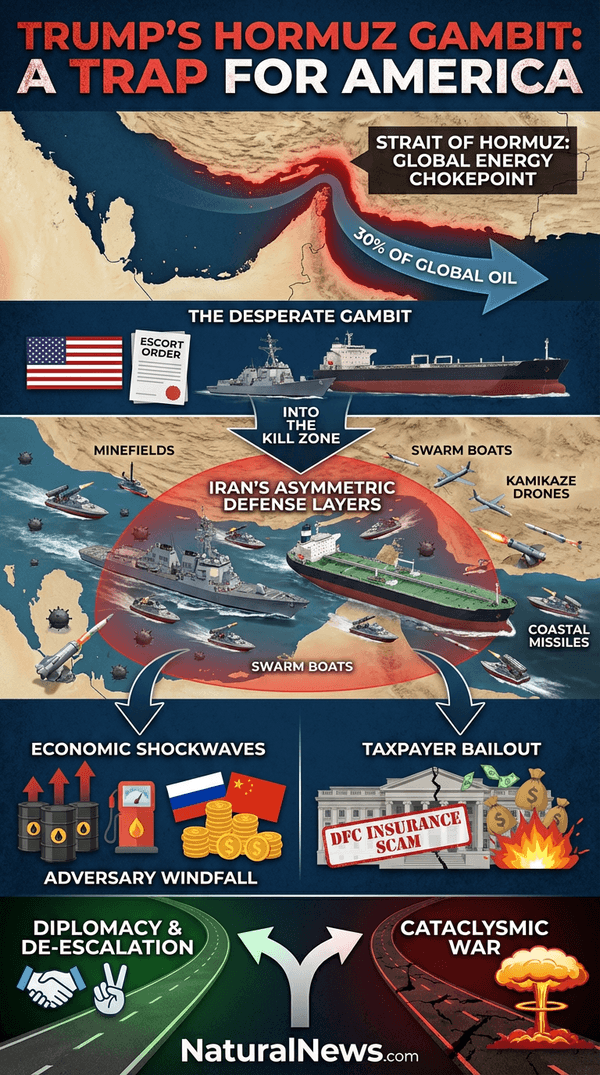
Explainer Infographic:
Submit a correction >>
Tagged Under:
current events, deception, government, national security, politics, propaganda, supply chain, supply chain collapse, Trump, war on Iran
This article may contain statements that reflect the opinion of the author
RECENT NEWS & ARTICLES