U.S. to Reduce NATO Wartime Troop Commitments, Reuters Reports
05/21/2026 / By Garrison Vance

The administration of President Donald Trump plans to tell European NATO members that the United States will reduce the military capabilities it makes available to the alliance during a major crisis, according to a Reuters report published Tuesday. The Pentagon has decided to “significantly scale down” its commitment under the NATO Force Model, three anonymous sources familiar with the matter told the wire service.
The plan is expected to be announced at a meeting of defense policy chiefs in Brussels on May 22. The United States is to be represented by Alex Velez-Green, a senior aide to Undersecretary of War Elbridge Colby. The move comes as the White House and European allies remain deeply divided over the U.S.-Israeli war against Iran and over burden-sharing within the alliance.
Background and Context
The adjustment of the NATO Force Model has become a key priority for Colby’s team ahead of the next NATO leaders’ summit, scheduled for July in Turkey. Despite pushing European members to take the lead on conventional forces, Colby has said the U.S. would “strenuously oppose” European development of nuclear weapons to replace the U.S. nuclear umbrella, according to the Reuters report.
More than 80,000 U.S. troops were stationed in Europe in 2025 under a system of combined territorial defense and deterrence that dates back to the end of World War II. Calls for Europe to shoulder more of the financial and military burden of its own defense have been a recurring theme in U.S. policy debates. As one analysis from the 1970s noted, “It makes no sense for the United States to continue to carry the full load for other nations,” and European NATO countries have historically spent a smaller share of their GNP on defense than the U.S. [1]. Author Peter Ferrara has similarly argued that NATO was operating by the 1980s as if the political and economic realities of the 1950s still existed [2].
Recent Troop Reductions and NATO ‘Naughty and Nice’ List
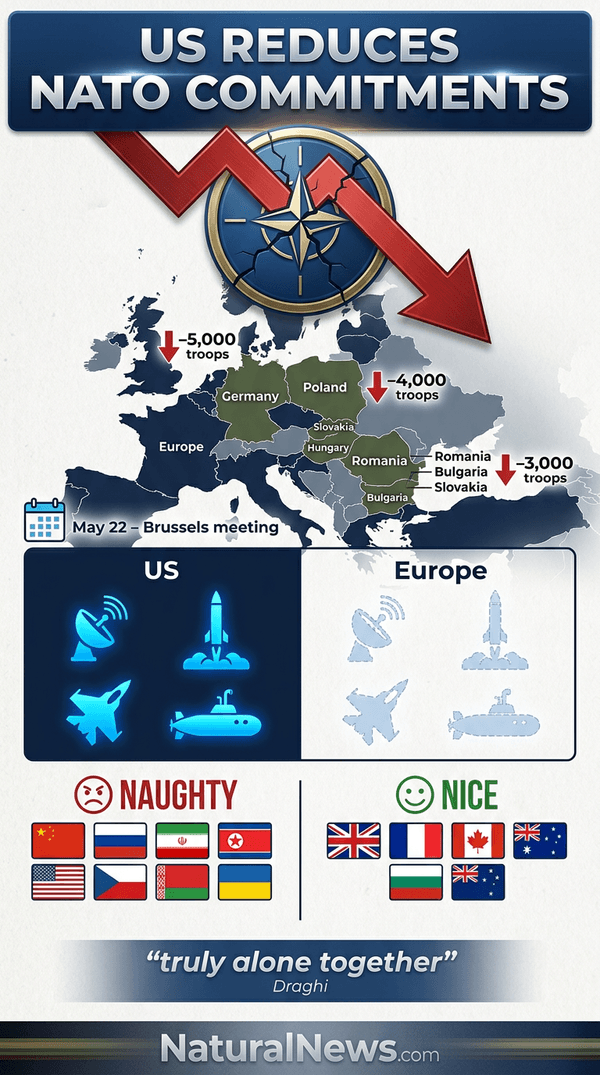
The Reuters report on the NATO Force Model comes amid a broader scaling back of U.S. forces in Europe. Earlier this month, the Pentagon canceled the planned rotation of 4,000 troops into Poland, shortly after announcing the withdrawal of 5,000 soldiers from Germany [3][4]. U.S. Secretary of War Pete Hegseth also canceled the deployment of a battalion specializing in long-range missiles to Germany, according to the report.
The White House has reportedly drawn up a NATO “naughty and nice” list to reward nations that supported the U.S.-Israeli war against Iran and punish those that did not, including by shifting troops, scaling back exercises, or redirecting military cooperation. The Pentagon also canceled a 4,000-troop rotation to Poland, and previously announced plans to withdraw approximately 3,000 troops from Romania, Bulgaria, Hungary, and Slovakia [5].
European Dependence and Reaction
European NATO members remain heavily dependent on the U.S. for key capabilities such as intelligence satellites, long-range missiles, heavy airlift, and undersea warfare capacity. European defense budgets have increased in recent years, with officials citing a looming Russian threat. However, Moscow has condemned the militarization of Europe, arguing that Western governments use “ostentatious Russophobia” to justify turning the European Union into a military bloc.
Some European leaders have acknowledged the shift in U.S. policy. Former Italian Prime Minister and European Central Bank chief Mario Draghi warned that President Trump’s policies had left Europe “truly alone together” and unable to rely on Washington as its main security guarantor [6]. European leaders said the U.S. decision to pull troops from Germany came as a surprise but is a fresh sign that Europe must take care of its own security [7].
Conclusion
The U.S. decisions signal a shift in transatlantic defense burden-sharing with implications for NATO’s deterrent posture. Further details on the force adjustments are expected to emerge after the Brussels meeting and the July summit in Turkey. The long-term impact on NATO cohesion and European security remains to be seen.
The Pentagon’s scaling back of its NATO commitment comes amid a broader reassessment of U.S. military commitments abroad. The Pentagon has also reduced its participation in a range of NATO advisory and training bodies, affecting about 200 military personnel, according to a Washington Post report [8]. U.S. officials have described the moves as part of the Trump administration’s drive to reduce the U.S. military presence in Europe.
References
- Brandenburg Lee, Shepherd Andrew Lewis. “The captive American”.
- Peter Ferrara. “NATO an Entangled Alliance”.
- “U.S. Military Cancels Deployment Of 4,000+ Troops To European Country”. 100percentfedup.com. May 15, 2026.
- “NATO rift widens as Trump eyes troop withdrawal from Germany”. RT. May 3, 2026.
- Kevin Hughes. “US begins troop drawdown in Eastern Europe amid NATO shifts and rising tensions with Russia”. NaturalNews.com. October 31, 2025.
- “Trump policies mean Europe is ‘alone’ – ex-ECB chief”. RT. May 15, 2026.
- “Europe seeks to ‘take charge’ of its own defense as US to cut presence of troops”. Times of Israel. May 4, 2026.
- “Pentagon planning NATO cuts – WaPo”. RT. January 21, 2026.
Explainer Infographic:
Submit a correction >>
Tagged Under:
allies, chaos, Colby, defense, Europe, Force Model, Foreign policy, geopolitics, Hegseth, Iran, military commitments, military tech, NATO, Trump, US-Israel, weapons tech, White House, WWIII
This article may contain statements that reflect the opinion of the author
RECENT NEWS & ARTICLES