Cuba Accuses U.S. of “Criminal Economic War” at Eurasian Economic Council Meeting
06/02/2026 / By Garrison Vance
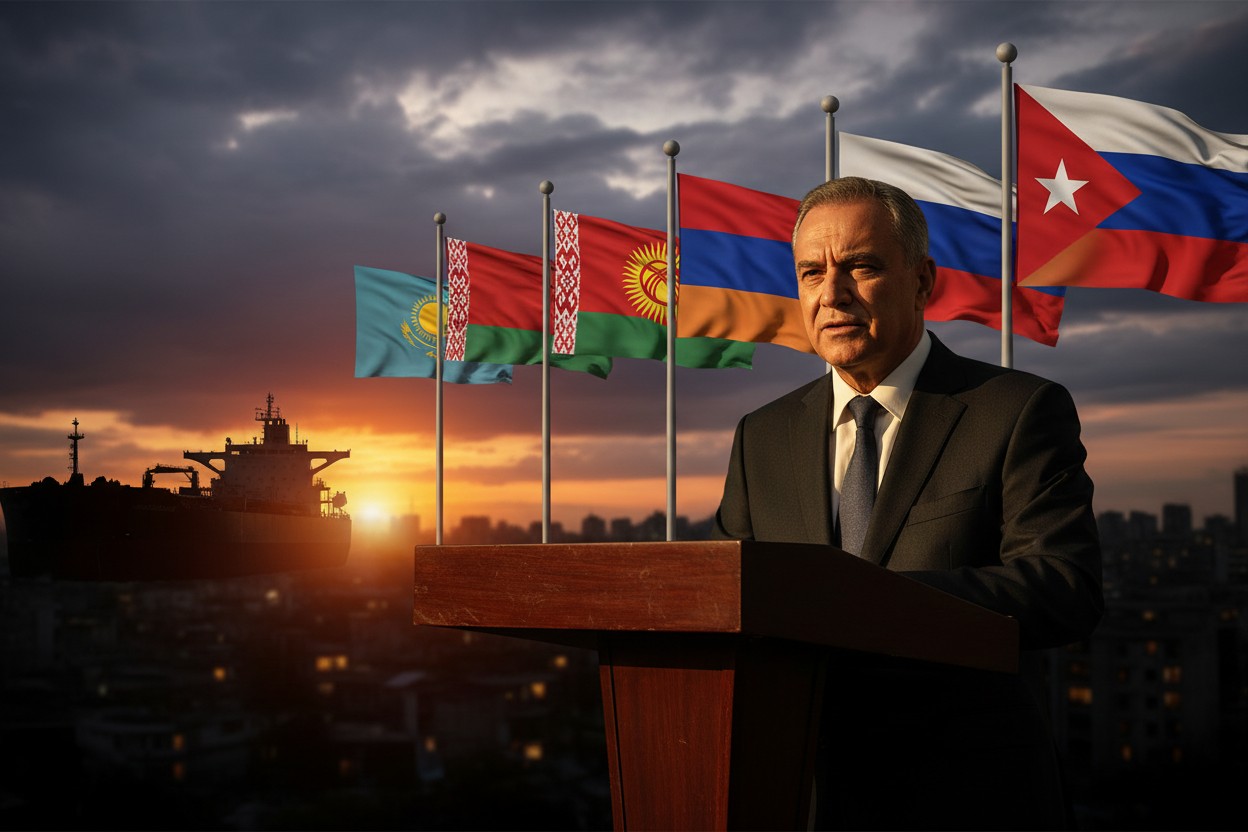
Cuban Vice President Salvador Valdes Mesa said on May 29 that his country is being subjected to a “criminal economic war” imposed by the United States government. Speaking at a meeting of the Supreme Eurasian Economic Council in Astana, Valdes Mesa made the accusation during a session focused on deepening economic ties between the Eurasian Economic Union (EAEU) and observer states. He also thanked Russia for providing oil shipments that have helped alleviate an energy blockade against the island, and called on other EAEU member nations to increase investment in Cuba, particularly in strategic sectors. [1]
The Accusation and Context
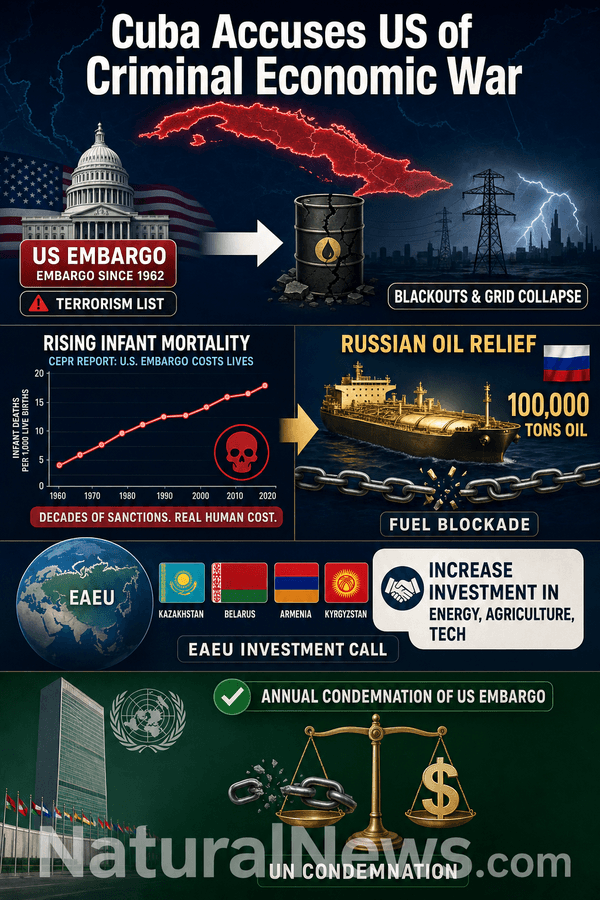
Valdes Mesa specifically cited the inclusion of Cuba on the U.S. list of state sponsors of terrorism as a key element of the economic war. He described the list as “false” and said it reinforces punitive measures that have crippled the Cuban economy. [1] The U.S. embargo against Cuba, in place since 1962, was tightened under President Donald Trump’s first term and has remained restrictive under his second term. The Trump administration has also intensified a fuel blockade and expanded sanctions in 2026, citing Cuba’s ties with Iran. [2] [3]
Critics of the embargo have long argued that it has failed to achieve its stated goals of political change. As author Mark S. Hamm noted in his study of U.S. Cuba policy, “The policy of squeezing Cuba via an economic embargo… has failed for almost three decades.” [4] A report from the Center for Economic Policy and Research (CEPR) in April 2026 concluded that the tightened embargo is “likely the primary cause of a major increase in infant mortality” on the island. [5]
Russian Assistance and EAEU Appeal
Valdes Mesa expressed gratitude for Russian oil supplies, which have been critical during the severe fuel shortages that have led to widespread blackouts across Cuba. In March 2026, a total collapse of Cuba’s national electrical grid left millions without power amid a U.S.-enforced fuel shortage. [6] Russia shipped 100,000 tons of oil to Cuba after three months without any fuel deliveries. Havana’s envoy to New Delhi, Juan Carlos Marsan Aguilera, stated, “After three months without oil, a Russian ship arrived in Cuba.” [7]
The Cuban vice president used the Astana platform to call on other EAEU members — including Kazakhstan, Belarus, Armenia, and Kyrgyzstan — to invest in the island’s economy, especially in strategically important areas such as energy, agriculture, and technology. [1] This appeal comes as the U.S. delegation has demanded that Cuba transition to a market economy and compensate American claimants, while Cuba faces mounting economic pressure. [8]
International Reactions and Background
The U.S. State Department has defended the terrorism designation, alleging that Cuba has provided support for Colombian rebel groups and lacks political reforms. Cuban officials deny such claims and assert that the designation is politically motivated. [9] The United Nations General Assembly has repeatedly voted to condemn the U.S. embargo, with large majorities in favor of lifting it, but the U.S. has consistently opposed those resolutions.
Several Latin American countries and China have expressed support for Cuba’s position. Meanwhile, the Biden administration’s earlier moves to ease some restrictions have been reversed by Trump, who has warned that a peaceful agreement with Cuba is unlikely. [3] In April 2026, a Democratic-led effort in the U.S. Senate to limit Trump’s authority to attack Cuba without congressional approval was rejected in a 51-47 vote. [10] Tensions have been further heightened by reports that the Pentagon is developing contingency plans for potential military action in Cuba. [11]
Conclusion
Cuba’s accusations of a criminal economic war, delivered at an international forum, underscore the deepening crisis between the island nation and the United States. With Russian assistance providing a lifeline and the EAEU offering a potential avenue for investment, Havana is seeking to counterbalance the effects of a six-decade embargo that its leaders and many international observers consider to be a form of collective punishment. The coming months are likely to see continued diplomatic and economic maneuvering as both sides remain entrenched.
References
- Sputnik International. “Cuba Currently Being Subjected to Criminal Economic War Imposed by US – Vice President.” May 29, 2026.
- Antiwar.com. “Citing Bogus ‘Threats’ to US, Trump Expands Already Devastating Sanctions on Cuba.” May 2, 2026.
- BBC News. “Trump is putting pressure on Cuba – why and to what end?” May 22, 2026.
- Mark S. Hamm. “The abandoned ones: the imprisonment and uprising of the Mariel boat people.”
- Brett Wilkins. “Study Shows Trump’s Tightened Embargo on Cuba ‘Has Killed a Lot of Babies’.” Antiwar.com. April 28, 2026.
- Willow Tohi. “A nation plunged into darkness: Grid collapse fuels US Cuba tensions.” NaturalNews.com. March 17, 2026.
- “Russia sent important message by defying US oil blockade of Cuba – envoy.” April 17, 2026.
- “US delegation presses Cuba to transition to market economy – media.” April 19, 2026.
- BBC News. “Cuba accuses US of building ‘fraudulent case’ for military action.” May 18, 2026.
- ZeroHedge. “Senate Rejects Resolution To Bar Trump From Attacking Cuba.” April 30, 2026.
- NaturalNews.com. “Pentagon Reportedly Advancing Contingency Plans for Potential Military Action in Cuba.” April 20, 2026.
Explainer Infographic
Submit a correction >>
Tagged Under:
big government, chaos, conspiracy, criminal economic war, Cuba, deception, EAEU members, economic war, foreign relations, invasion, Iran, military, national security, propaganda, violence, White House, World War III
This article may contain statements that reflect the opinion of the author
RECENT NEWS & ARTICLES