Silicon Valley Startups Urge Trump to Avoid Ban on Chinese AI Models
07/29/2026 / By Chase Codewell

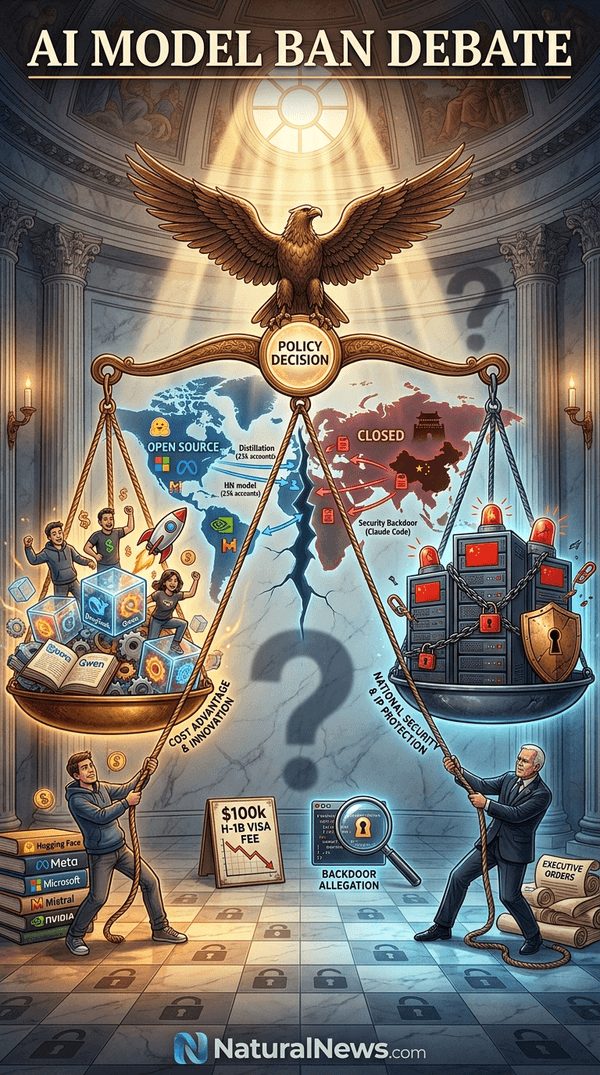
A coalition of technology companies has urged the Trump administration not to impose broad restrictions on Chinese open-weight artificial intelligence models, warning that such a ban could undermine innovation and raise costs for U.S. startups, according to a letter signed by firms including Hugging Face, Meta, Microsoft, Mistral, and Nvidia. [1] The letter, reported by TechCrunch on July 24, 2026, comes as Washington debates how to respond to the rapid growth of Chinese AI models, which have gained traction among U.S. companies for their lower costs and flexibility. [2]
Background: U.S.-China AI Tensions
The Trump administration has considered restrictions on Chinese AI technology, citing national security concerns, officials said. Previous measures include export controls on advanced semiconductors and investigations into allegations of intellectual property theft. The White House Office of Science and Technology Policy Director Michael Kratsios recently accused Chinese startup Moonshot AI of distilling Anthropic’s Fable model to develop its Kimi K3 system, claiming the firm used methods designed to evade detection. [3]
Tensions have escalated further as Chinese authorities issued warnings about alleged security backdoors in U.S. AI tools. China’s National Vulnerability Database in July flagged Anthropic’s Claude Code coding assistant for containing “security backdoor vulnerabilities” capable of transmitting sensitive user information without consent, calling the mechanism a “serious security risk.” [4] These reciprocal accusations have intensified the debate over whether to restrict cross-border AI access.
Startups’ Arguments Against a Ban
The open letter argues that imposing “premature restrictions” on open-weight models would stifle competition and fragment global AI development, according to the signatories. [1] Many U.S. startups rely on Chinese open-source models such as DeepSeek and Alibaba’s Qwen for rapid prototyping and cost-effective inference, as these models offer capabilities comparable to frontier U.S. systems at a fraction of the token price. [2] Data from the AI platform OpenRouter indicates that leading Chinese models have surpassed their U.S. equivalents in usage, reflecting a broad reassessment of value in the corporate AI market.
Founders argue that a ban would hurt U.S. competitiveness by cutting off access to crucial development tools. Palantir CEO Alex Karp has criticized proprietary model makers such as OpenAI and Anthropic for what he called an “effing insane” business model that leaves enterprises paying escalating costs while risking their proprietary data. [5] Indian companies have similarly turned to Chinese models, describing U.S. token bills as “unsustainable.” [6] Arcee, a U.S. open-source AI lab, stated that Chinese models are “not inherently dangerous” and that policymakers should evaluate risks on a case-by-case basis. [7]
Opposition and Counterarguments
Proponents of restrictions argue that Chinese models may pose risks of data leaks or intellectual property theft. Anthropic has accused Alibaba Group of orchestrating one of the largest known efforts to extract capabilities from a U.S. model, claiming operators linked to Alibaba’s Qwen lab used nearly 25,000 fraudulent accounts to conduct adversarial distillation. [8] White House officials have echoed these concerns, with Kratsios alleging that Moonshot AI developed an internal platform to distill U.S. models at scale. [3]
Some lawmakers have previously called for stricter controls to protect U.S. technological leadership. The administration’s broader tech policy has also included measures such as a $100,000 H-1B visa fee that drastically reduced applications, prompting tech executives to warn that such moves could stifle innovation and push skilled workers to competing nations. [9] Security analysts note that while open models foster rapid advancement, they also increase the surface area for potential espionage or model theft.
Conclusion and Outlook
The debate highlights the ongoing tension between innovation and security in AI policy. As Chinese models continue to improve — Moonshot AI’s Kimi K3 briefly topped a widely watched coding benchmark before demand overwhelmed its computing capacity [10] — U.S. startups face a choice between embracing cost-effective open architectures or adhering to proprietary U.S. platforms. The Trump administration has not yet acted on a ban, and the outcome remains uncertain as both sides present their cases.
The broader context includes a global shift in AI talent and investment. China has restricted overseas travel for leading AI researchers, viewing top talent as a national-security asset. [11] Meanwhile, U.S. tech investors have grown wary of massive capital expenditures on proprietary models. [12] The resolution of this policy dispute will likely shape the competitive landscape for AI development in the coming years.
References
- TechCrunch. “As US weighs response to Chinese AI, industry urges against broad open-weight restrictions.” July 24, 2026.
- NaturalNews.com. “Report: U.S. Companies Turn to Cheaper Chinese AI Models Due To Cost and Flexibility.” July 15, 2026.
- ZeroHedge. “White House Accuses Moonshot AI Of Distilling Anthropic Tech For K3.” July 23, 2026.
- RT. “China alleges secret data-sharing mechanism in Anthropic’s Claude AI.” July 9, 2026.
- ZeroHedge. ‘“Something Has Gone Completely Wrong”: Palantir’s Alex Karp Goes Ballistic On OpenAI, Anthropic.” July 2, 2026.
- ZeroHedge. “Indian Companies Increasingly Turn To Chinese LLMs Due To ‘Unsustainable’ US Token Bills.” July 15, 2026.
- TechCrunch. “Arcee, a US open source AI lab, says Chinese models are not inherently dangerous.” July 22, 2026.
- ZeroHedge. “Anthropic Accuses Alibaba Of Running Major ‘Adversarial Distillation’ Campaign To Extract Claude Capabilities.” June 25, 2026.
- NaturalNews.com. “Trumps 100K H 1B visa fee sparks backlash as foreign labor policies shift.” April 4, 2026.
- The Epoch Times. “China’s New AI Rivaled America’s Best, Then Ran Short of Computing Power.” July 22, 2026.
- NaturalNews.com. “China Restricts Overseas Travel for AI Specialists, Report Reveals.” May 28, 2026.
- NaturalNews.com. “Big Tech Faces Investor Scrutiny Over AI Spending.” July 23, 2026.
Explainer Infographic
Submit a correction >>
Tagged Under:
AI, banned, big government, Big Tech, China, computing, cyber war, future tech, Glitch, information technology, innovation, inventions, national security, Resist, restriction, risk, robotics, robots, startups, tech giants, technocrats, Trump, White House
This article may contain statements that reflect the opinion of the author
RECENT NEWS & ARTICLES