Trump Announces Phased Hamas Disarmament Deal, But Israel Skeptical
07/31/2026 / By Garrison Vance

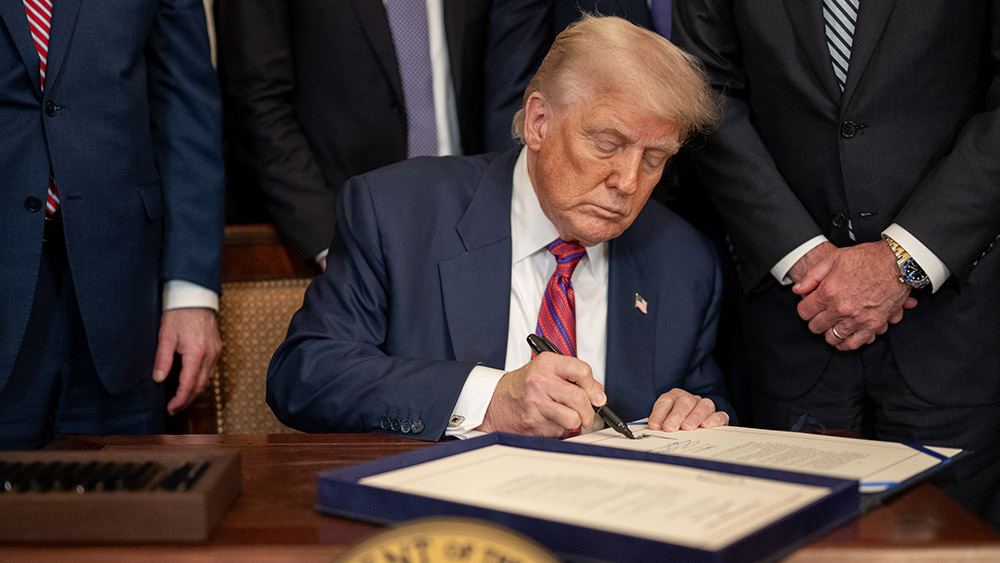
U.S. President Donald Trump announced Thursday evening, July 30, that the Washington-led Board of Peace (BOP) has reached an agreement for Hamas to disarm in “carefully structured phases,” according to a post on his Truth Social platform.
In the post, Trump called the agreement “a critical step towards Gaza finally being governed by a new Palestinian government” and said Israel would withdraw from Gaza “as disarmament is completed,” according to the BBC [1]. However, a U.S. official said Israel remains “skeptical” that Hamas will follow through on the agreement.
As of 7 p.m. Eastern Daylight Time Thursday, neither the Israeli government nor Hamas had issued an official response. A senior Hamas official told the BBC that the group had agreed to a plan to completely disarm in Gaza and that an official statement would be released soon [1]. The Saudi-owned newspaper Asharq Al-Awsat reported that Hamas was nearing an agreement with mediators over its weapons [2].
Reported Terms of the Agreement
According to a report by Amit Segal, chief political analyst for Israel’s N12News, the agreement calls for Hamas to surrender all weapons within “weeks” to depots guarded by multinational forces and to end all military activity and recruitment. Under the reported terms, Israel would not withdraw its military behind the “yellow line” until disarmament is complete.
The line marks the boundary of the area of Gaza under Israeli control since the October 2025 ceasefire; Israeli troops pulled back to the line, which left about 53% of the Strip under Israeli control [3]. Washington has previously circulated a draft United Nations resolution proposing an International Stabilization Force (ISF) to act as an “enforcement” body, disarming Hamas and training Palestinian police [4].
The first step of the process, according to U.S. and BOP officials, is the establishment of a “complete monopoly of weapons,” beginning with police firearms and followed by heavy weapons, weapons depots and tunnels. The U.S. official said militias and clans in Gaza would be “demilitarized and decommissioned” as part of the process. Israel’s security cabinet has voted to approve the limited entry of the ISF, which would include 200 troops from “friendly countries,” Israeli officials told the Times of Israel [5].
Israeli Skepticism and Reported Concerns
The Jerusalem Post (JPost) reported that the 15-point document under discussion did not “adequately address” Israeli demands for the full demilitarization of the Gaza Strip. According to the outlet, Israeli concerns were conveyed to former British Prime Minister Tony Blair, a mediator on the BOP.
Israel’s stated position has long included the complete demilitarization of the Strip and a buffer zone between Israel and Gaza [6]. Israeli defense officials have also warned of potential escalation on other fronts, including a “hot summer” on the border with Lebanon [7].
The U.S. official acknowledged Israeli doubts about the agreement. “They’re very skeptical that Hamas will disarm. But again, they’re not really being asked to do much in the process because this isn’t really a trust deal,” the official said. They described the deal as conditions-based, adding that everyone must follow the obligations they have taken.
The BOP has previously warned that failure to accept a disarmament proposal would render the terms of the October 2025 ceasefire “null and void” [8]. Hamas officials have said on prior occasions that the group would not commit to disarming and intended to remain the primary security force in Gaza [9].
Phased Implementation and Verification
According to officials, the ISF will support the technical process, relying on a study of the situation conducted over recent months. Once the disarmament phase is verified by both sides, Hamas will transfer civilian and security functions to the National Committee for the Administration of Gaza, the U.S.-endorsed body that is to assume civilian governance of the Strip [10]. Israel will begin a phased withdrawal from Gaza once it is satisfied there is no internal threat, according to a timetable that has yet to be finalized.
“And last but not least, is the main principle of reconstruction and the reconstruction of the Gaza Strip,” the U.S. official said. BOP members have committed $7 billion to Gaza relief, with Washington pledging an additional $10 billion [11].
The reconstruction fund administered by the World Bank has faced delays. As of late May, it held zero dollars despite approximately $17 billion in pledges [12].
Conclusion: Official Responses Still Pending
Neither the Israeli government nor Hamas had officially commented on Trump’s announcement as of 7 p.m. EDT Thursday. The Hill reached out to both sides for comment.
The U.S. official framed the deal as conditions-based, while JPost reported that Israeli concerns about full demilitarization remain unresolved. The announcement came after months in which the Gaza framework advanced in “baby steps,” according to five officials involved in or familiar with the planning [13].
References
- “LIVEHamas says it agrees to disarm in Gaza after Trump announces Board of Peace plan, with Israel yet to comment.” BBC News. July 31, 2026.
- “2 kids reported killed in Gaza strikes; Hamas said nearing deal with mediators on its arms.” The Times of Israel. July 30, 2026.
- “Netanyahu Admits Israel Is Taking More Territory in Gaza in Violation of Ceasefire Deal.” Antiwar.com. May 18, 2026.
- Ramon Tomey. “Washington seeks UN approval for International Security Force to be deployed in Gaza.” NaturalNews.com. November 5, 2025.
- “Cabinet gives initial approval for international force in Gaza, with some 200 troops.” The Times of Israel. July 27, 2026.
- “Trends-Journal-2024-02-09.”
- “Trends-Journal-2024-07-23.”
- “Israel Says Ceasefire Void If Hamas Refuses to Disarm.” NaturalNews.com. May 10, 2026.
- Zoey Sky. “Hamas refuses to give up arms and Gaza control threatening fragile truce.” NaturalNews.com. October 22, 2025.
- “Hamas Dissolves Gaza Emergency Committee, Urges Swift Entry of U.S.-Backed Technocrats.” NaturalNews.com. July 7, 2026.
- Yasmine El-Sabawi. “‘Board of Peace’ members commit $7bn to Gaza relief, US pledges further $10bn.” Middle East Eye. February 19, 2026.
- “Gaza’s ‘Board of Peace’ holds zero dollars despite billions pledged.” NaturalNews.com. May 31, 2026.
- “Slowed by Hamas’s grip and Israeli politics, Gaza plan advancing in ‘baby steps,’ officials say.” The Times of Israel. July 20, 2026.
Explainer Infographic

Submit a correction >>
Tagged Under:
big government, Board of Peace, chaos, demilitarization, diplomacy, disarmament, Donald Trump, foreign relations, Gaza Strip, Hamas, International Stabilization Force, Israel, Israel-Palestine war, law enforcement, military, national security, skepticism, terrorism, Tony Blair
This article may contain statements that reflect the opinion of the author
RECENT NEWS & ARTICLES