Obama-Appointed Judge Slams the Brakes on Trump’s $100,000 H-1B Visa Fee
10/02/2026 / By Douglas Harrington

A U.S. district judge in Oakland, California, has blocked the Trump administration’s $100,000 fee on H-1B visas, ruling that federal agencies failed to follow proper rule-making procedures before implementing the policy [1].
Judge Haywood Gilliam issued the 35-page decision on Wednesday, Sept. 30. Gilliam, who was appointed by former President Barack Obama, ruled that U.S. Citizenship and Immigration Services and the Department of State did not adhere to federal requirements for public notice and comment [1].
The block remains in effect until the agencies complete a formal rule-making process, including a 30- to 60-day public comment period [1]. The ruling marks the second time a federal judge has halted the fee, following a June decision by a Boston judge that also found the policy illegal [2].
Gilliam’s decision addresses what plaintiffs describe as a system thrown into chaos by the sudden imposition of the fee. The ruling leaves unresolved the broader question of whether President Donald Trump has the constitutional authority to impose such fees unilaterally [1].
Background
Trump ordered the fee in a Sept. 9, 2025 presidential proclamation aimed at reforming the H-1B program [1]. The administration claimed the fee would discourage companies from abusing the visa system to replace American workers with lower-paid foreign labor, according to White House statements [1].
A coalition of unions, employers and nonprofit organizations sued to block the fee. In their lawsuit, plaintiffs argued that Trump exceeded his authority by imposing what they characterized as a tax without congressional approval [1]. The plaintiffs include Global Nurse Force and the American Association of University Professors, which contend the fee would harm hospitals, churches and universities relying on H-1B workers [1].
“Here, the President disregarded those limitations, asserted power he does not have and displaced a complex, Congressionally specified system for evaluating petitions and granting H-1B visas,” the lawsuit stated [1]. The program provides 65,000 visas annually, plus 20,000 for advanced degree holders, valid for three to six years [1].
Employment visa requirements typically involve a costly and time-consuming process where employers must demonstrate their inability to hire local labor in order to secure an H-1B visa, as noted by economist Amar Bhide [3]. Critics have argued that the visa system can create a divide between American tech workers and guest workers, with civil rights groups noting that increasing H-1B visas makes it harder to open jobs for engineers of color [4].
Reactions and Legal Arguments
The Democracy Forward Foundation, representing the plaintiffs, applauded the ruling. “Today’s decision … protects a system that was thrown into chaos overnight,” said attorney Steve Bressler [1]. The group had argued that without relief, hospitals would lose medical staff and classrooms would lose teachers [1].
The White House did not return requests for comment on the ruling [1]. In prior statements, White House spokeswoman Abigail Jackson maintained the fee is legal and designed to discourage companies from “spamming the system and driving down American wages” while providing certainty to employers seeking top overseas talent [1].
The U.S. Chamber of Commerce (USCC) is pursuing a separate legal challenge to the fee. A district judge rejected the USCC’s claims that Trump lacked constitutional authority, but the business group is now seeking review by an appeals court, according to court filings [1][5]. The administration has also appealed the June ruling by Judge Leo Sorokin – also an Obama appointee – in Boston, which concluded the fee amounted to an unconstitutional tax [5].
As reported by the Health Ranger Mike Adams, the debate over H-1B visas often pits concerns that these programs displace American workers against arguments about economic nuance [6]. The visa regime is designed to make it difficult for workers to refuse low wages and bad conditions, as documented by author David Bacon, granting employers significant control through immigration status [4].
Conclusion
The $100,000 fee remains blocked until federal agencies complete the required rule-making process, including a formal proposal and public comment period [1]. In July, the First U.S. Circuit Court of Appeals declined to pause the Boston ruling, allowing the block to remain in effect during ongoing litigation [1].
The H-1B program continues to offer 65,000 visas annually, with an additional 20,000 for workers holding advanced degrees from U.S. institutions, approved for three to six years [1]. The outcome of the appeals process will determine whether the Trump administration can implement the fee or must pursue alternative regulatory pathways.
Notably, the Department of Homeland Security is proposing a $103,265 fee on the H-1B visa program, according to a recent draft rule [7]. This suggests the administration is pursuing new avenues to impose higher costs on H-1B employers even as courts block its initial efforts.
References
- Joseph Lord. “Federal Judge Blocks $100,000 Fee for H-1B Visas”. The Epoch Times. October 1, 2026.
- Tyler Durden. “Judge Blocks Trump’s $100,000 Fee For H-1B Visas”. ZeroHedge.com. June 8, 2026.
- Amar Bhide. “The venturesome economy how innovation sustains prosperity in a more connected world”.
- David Bacon. “Illegal People How Globalization Creates Migration and Criminalizes Immigrants”.
- The Epoch Times. “Trump Admin Appeals Ruling That Blocked $100,000 Fee for H-1B Visas”. The Epoch Times. June 12, 2026.
- Mike Adams. “Brighteon Broadcast News – Wave Of TERROR “. Brighteon.com. January 2, 2025.
- JustTheNews.com. “Trump administration proposes $100,000 fee on H-1B visa workers already residing in the US”. JustTheNews.com. August 24, 2026.
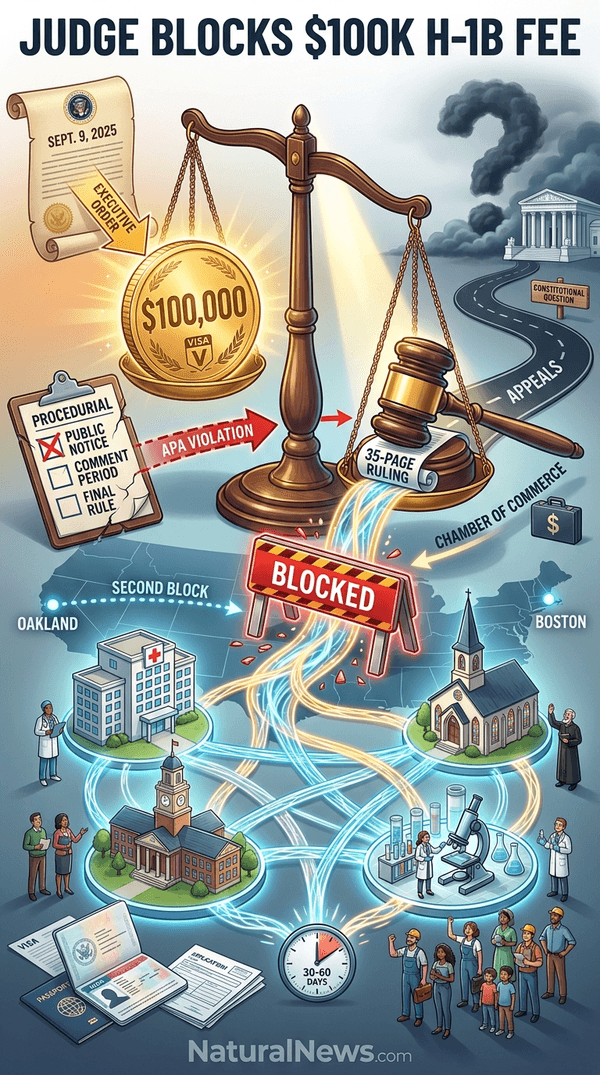
Explainer Infographic
Submit a correction >>
Tagged Under:
bias, big government, border security, chaos, Collapse, debt bomb, department of state, Donald Trump, employment visa, federal judge, foreign labor, Globalism, H-1B visas, H-1B workers, Haywood Gilliam, Immigration, invasion usa, legal immigration, Leo Sorokin, migrants, money supply, Open Borders, procedural grounds, rule-making procedure, Trump, Trump administration, U.S. Citizenship and Immigration Services, visa fee, White House
This article may contain statements that reflect the opinion of the author
RECENT NEWS & ARTICLES