Trump Considering Suspending Federal Gas Tax as States Lower Fuel Levies
10/10/2026 / By Sterling Ashworth
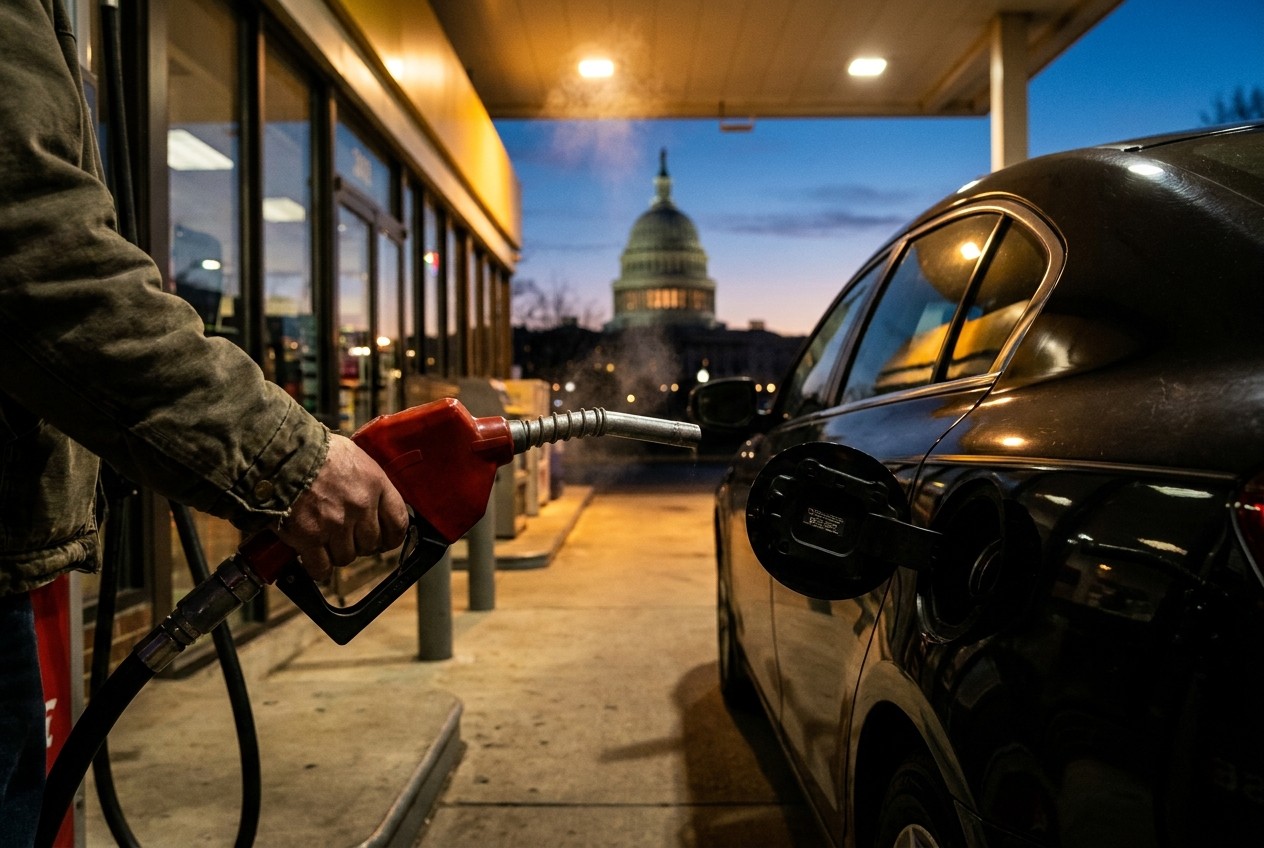
On Oct. 6, President Donald Trump said that he is considering suspending the federal gas tax. Trump told reporters at the White House that his administration is weighing the option as fuel prices remain elevated weeks before the midterm elections.
“We’re thinking about that,” Trump said when asked whether the federal gas tax should be suspended, according to a pool report. He did not provide additional details or a timeline.
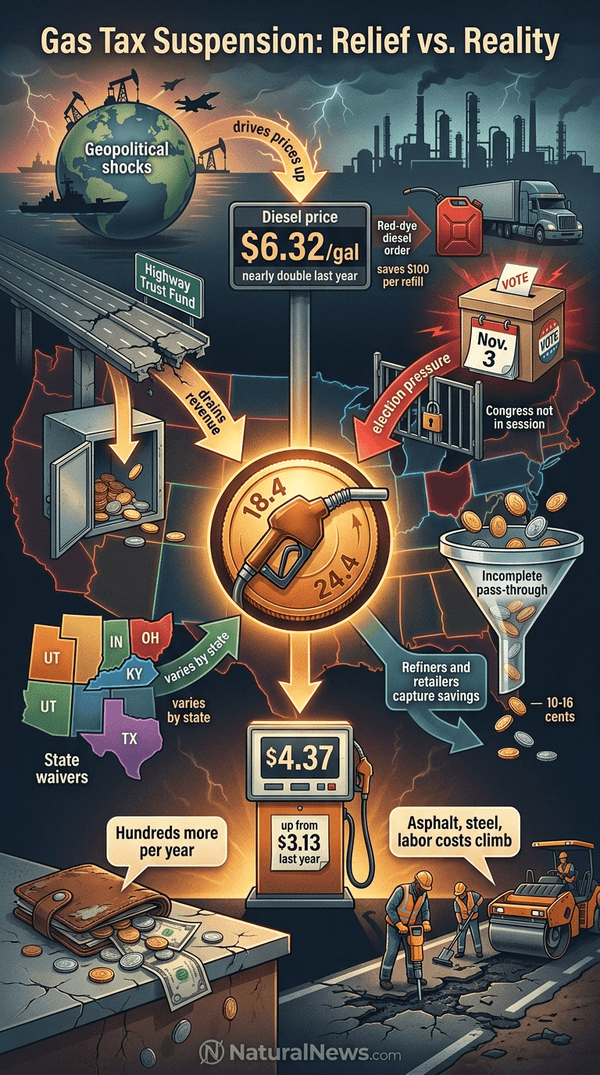
According to federal data, the federal gas tax adds 18.4 cents per gallon to gasoline and 24.4 cents per gallon to diesel, and the revenue finances highway and bridge maintenance [12]. Congress is not scheduled to return until after the Nov. 3 election, and any suspension would require legislative action, officials said.
Several states have already passed temporary waivers or pauses of their own fuel taxes.
Federal Tax and Congressional Timing
The federal gasoline tax is 18.4 cents per gallon, and the diesel tax is 24.4 cents per gallon, according to U.S. Energy Information Administration (EIA) figures cited in reports. The tax revenue flows to the Highway Trust Fund, which finances road and bridge construction and maintenance across the country.
Trump would need Congress to pass a suspension, but both the House and Senate are not scheduled to return to Washington until after the election.
The remarks marked the second time this year that Trump has publicly floated the idea. A pause on the gas tax would likely lower prices between 10 and 16 cents a gallon, according to research from the Bipartisan Policy Center [1].
The federal government has never suspended its gas tax, though states have suspended their own fuel levies, and economic studies of those suspensions found that less than the full amount of the suspended tax typically is passed on to consumers in lower prices [2].
State Actions to Lower Fuel Costs
Ohio Republican Gov. Mike DeWine signed legislation waiving through Dec. 31 his state’s 38.5-cent gas tax and 47-cent diesel tax, according to state officials [12]. Ohio lawmakers approved a 90-day suspension of the state’s gasoline tax on Sept. 30, nine days after both major candidates for governor announced they supported the idea.
GOP gubernatorial nominee Vivek Ramaswamy said he worked with fellow Republicans to craft legislation that passed with support from some Democrats [3].
Utah Republican Gov. Spencer Cox has lowered his state’s levies by 6 cents through the end of the year, according to state action [12]. Georgia Republican Gov. Brian Kemp suspended through at least Oct. 29 his state’s 33.3-cent gas tax and 37.3-cent diesel tax, officials said [12].
Indiana Republican Gov. Mike Braun suspended a 7% gasoline use tax and a 37-cent excise tax, saving drivers roughly 59 to 61 cents per gallon, but left in place a 63-cent per gallon diesel tax, coupled with a “red dye” expansion, according to state documents. Kentucky Democratic Gov [12]. Andy Beshear paused automatic inflation adjustments to fuel taxes, according to state officials [12].
Both Republican- and Democratic-led states have passed temporary waivers of their gas taxes or taken measures to ease restrictions on the purchase of “red dye” and ethanol blend fuels [12].
Texas Gov. Greg Abbott issued a statewide disaster proclamation on Monday certifying a diesel fuel shortage, a move that Texas Railroad Commissioner Wayne Christian called a “common-sense step towards expanding access to cheaper diesel” [4]. With Election Day less than a month away, lawmakers in several states are suspending gas taxes or rolling back regulations on diesel fuel as voters grow increasingly frustrated with rising fuel costs [5].
Energy Prices and Federal Measures
The average cost of diesel is $6.32 per gallon, according to AAA data, down from an all-time high of $6.53 on Sept. 22, but still nearly double the $3.68 paid one year ago, indirectly increasing other costs. Gasoline is also up significantly, currently averaging $4.37 per gallon, up from $3.13 last year [12].
The average price for a gallon of regular unleaded in the United States was $4.36 on Oct. 6, up from $3.13 a year ago, according to the U.S. Energy Information Administration [12].
On Oct. 5, Trump signed an executive order allowing truckers to purchase tax-free “red dye” diesel through Dec. 31, according to the White House. The order is expected to free up more domestic fuel for the public and reduce prices at the pump by supplying truckers with tax-free diesel typically used in tractors and off-road machinery [12].
The White House estimates the action will save truckers about $100 per refill, according to a fact sheet [12]. Texas, Louisiana, Alabama, North Carolina, Tennessee, Nebraska, and Missouri have waived red-dye diesel restrictions in recent weeks [6].
G-7 nations, including the U.K., France, Germany, Italy, Canada, and Japan, collectively agreed on Oct. 2 to release 100 million barrels of oil and diesel from strategic reserves to tamp down prices [12]. Market analysts explained that the price increases followed large jumps caused by the Iran war and Ukrainian attacks on Russian refineries.
The war, which began Feb. 28 with U.S. and Israeli strikes on Iran, has driven fuel costs higher throughout the year [7].
As of early Saturday morning, AAA data put the national average retail diesel price at about $6.48 a gallon, slightly below its recent record high, while Brent crude settled on Friday around $104.30 a barrel [8].
Outlook and Political Context
Trump has been attempting to lower energy costs, which have fueled inflation, in the run-up to the election, according to his public statements. The administration has been working to contain energy prices as soaring fuel costs threaten to shape the political landscape weeks before the Nov. 3 congressional elections [9].
Suspending the federal gas tax would require congressional approval, and no vote is scheduled before the election, officials said. Analysts note that state measures have varying durations and effects on pump prices.
A move by the Trump administration to suspend the federal gasoline tax would offer only modest relief to U.S. drivers socked by soaring fuel costs, according to tax and energy experts [10].
According to the White House, further federal action remains uncertain. Republican lawmakers have introduced proposals in the House and Senate to temporarily suspend the federal excise tax on gasoline and diesel fuel, a move publicly supported by Trump amid rising fuel prices [11].
References
- “Trump says he’s considering gas tax suspension to ease costs”. https://kdhnews.com/news/world/trump-says-he-s-considering-gas-tax-suspension-to-ease-costs/article_8ca09c80-434a-53e0-818e-36b0fd8934cf.html
- “Suspension of the Federal Gas Tax: In Brief”. Congress.gov. https://www.congress.gov/crs_external_products/R/PDF/R48948/R48948.1.pdf
- “Ohio Lawmakers Pass Gasoline-Tax Holiday, a Major Issue in Governor’s Race”. https://theepochtimes.com/us/ohio-lawmakers-pass-gasoline-tax-holiday-a-major-issue-in-governors-race-6097038
- “Texas Gov. Abbott issues disaster declaration citing diesel fuel crisis, waives restrictions”. https://justthenews.com/nation/states/center-square/abbott-issues-disaster-declaration-diesel-fuel-crisis-waives?utm_source=justthenews.com&utm_medium=feed&utm_campaign=external-news-aggregators
- “With election pressure mounting, states move to suspend fuel taxes”.
https://stateline.org/2026/10/06/with-election-pressure-mounting-states-move-to-suspend-fuel-taxes/ - “Trump Order Makes Red-Dyed Diesel Available for On-Road Use: What to Know”. https://theepochtimes.com/us/trump-order-makes-red-dyed-diesel-available-for-on-road-use-what-to-know-6100267
- “Veterans in Virginia Signal Discontent With Trump Over Iran War Ahead of Midterms”. https://www.naturalnews.com/2026-09-30-virginia-veterans-signal-discontent-trump-iran-war.html
- “Diesel Export Ban Off The Table? Ted Cruz Relays White House Assurances To Refinery Heads”. https://www.zerohedge.com/energy/diesel-export-ban-table-ted-cruz-relays-white-house-assurances-refinery-heads
- “Trump eyes federal gas tax holiday as diesel tops $6 and midterms near”. https://www.naturalnews.com/2026-10-07-trump-federal-gas-tax-holiday-midterms.html
- “Trump wants to suspend the federal gas tax. How much would that help drivers?”. https://www.cbsnews.com/news/federal-gas-tax-suspension-impact-gas-prices/
- “GOP Lawmakers, Trump Push Proposals to Suspend Federal Gas Tax”.
https://tax.thomsonreuters.com/news/gop-lawmakers-trump-push-proposals-to-suspend-federal-gas-tax/ - “Trump says he’s considering suspending federal gas tax as states lead effort to lower costs”. https://nypost.com/2026/10/06/us-news/trump-says-hes-considering-suspending-federal-gas-tax-as-states-lead-effort-to-lower-costs/
Explainer Infographic
Submit a correction >>
Tagged Under:
big government, Collapse, diesel, diesel prices, diesel shortage, Donald Trump, energy costs, energy supply, executive order, federal gas tax, fuel prices, fuel supply, gas, gas prices, gas taxes, gasoline, gasoline tax, Inflation, power, supply crunch, tax-exempt diesel, White House
This article may contain statements that reflect the opinion of the author
RECENT NEWS & ARTICLES