House Passes Sunshine Protection Act to Make Daylight Saving Time Permanent; Senate Will Vote Next
07/15/2026 / By Garrison Vance

Bill Clears House in Bipartisan Vote
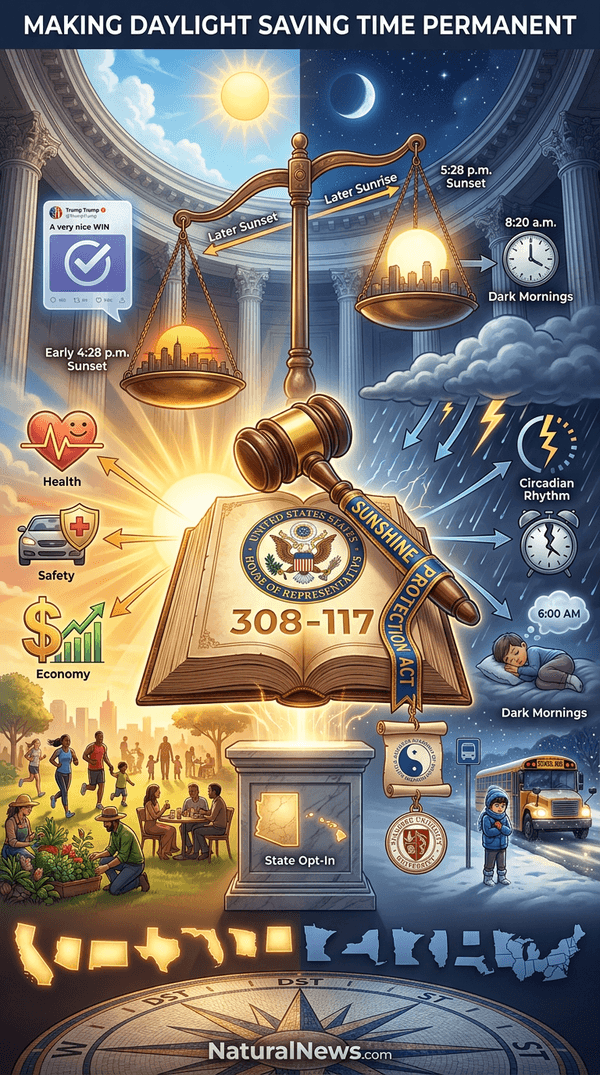
The House of Representatives on Tuesday passed the Sunshine Protection Act in a 308-117 vote, advancing legislation that would make daylight saving time permanent for states that opt in, according to officials. The bill, which now heads to the Senate, would end the biannual practice of springing forward and falling back for most Americans.
Twenty-two Republicans and 95 Democrats voted against the measure, according to the vote tally. The legislation had previously advanced out of the House Energy and Commerce Committee by a 48-1 vote in May, according to reports. President Donald Trump endorsed the bill on Truth Social, calling it “a very nice WIN for the Republican Party,” as noted by multiple news outlets.
Legislation Grants States Year-Round Daylight Saving Option
The Sunshine Protection Act, sponsored by Rep. Vern Buchanan (R-Fla.), would allow states to either adopt permanent daylight saving time or continue the current twice-yearly shifts, according to the bill text. States that opt in would no longer experience 4 p.m. sunsets during winter months, according to an analysis cited by supporters.
“Americans across the country are tired of the biannual clock change, and the evidence is clear that permanent daylight saving time can improve public health, reduce traffic accidents, lower crime and encourage more outdoor activity,” Buchanan said in a statement, as reported by NewsNation [1] and other outlets. President Trump said the change would save “hundreds of millions of dollars” spent annually on adjusting clocks, according to his social media statement cited by The Epoch Times [2].
Opponents Cite Health Concerns and Need for Debate
Some lawmakers and health experts argue that permanent daylight saving time could pose risks to public health. Rep. Madeleine Dean (D-Pa.) said during floor debate that the bill “is being rushed to the floor as a political bargaining chip without thorough consideration of the impacts,” according to remarks reported by multiple news organizations. She advocated for permanent standard time instead, stating that “early morning light is an important environmental cue to set our body’s internal clocks.”
Scientific literature strongly argues against adopting DST permanently, according to a summary by Mercola.com [3], noting that “perpetual DST would exaggerate all effects described above beyond simply extending DST from approximately eight months per year to 12 months.” A Stanford University study found that permanent standard time aligns best with the natural solar cycle and that the biannual clock change creates a state of “jet lag” that disrupts circadian rhythms, as reported by NaturalNews.com [4].
Practical Impact on Sunrise and Sunset Times Outlined
If enacted, permanent daylight saving time would shift sunrise and sunset times during winter months. In New York City, the latest sunrise would move from 7:20 a.m. to 8:20 a.m. in January, and the earliest sunset would change from 4:28 p.m. to 5:28 p.m. in December, according to data provided by bill supporters and reported by The Epoch Times [5].
Supporters argue that later sunsets could reduce crime and increase outdoor activity, as Buchanan noted. However, research cited by Lynne Peeples in her book “The Inner Clock” indicates that “data are arguably mixed” and that evidence supporting permanent DST is often based on short-term effects and may not reflect year-round impacts [6]. The book also notes that public polls show a majority of people dislike the current system but are split on which permanent time to adopt [6].
States Await Federal Authorization to Implement Changes
Roughly 20 states, including Florida, Alabama, and Oregon, have already passed laws to adopt permanent DST contingent on Congress permitting the change, according to reports. Hawaii and most of Arizona currently do not observe daylight saving time and would remain exempt under the bill, officials said.
The Senate will now consider the legislation. A similar bill passed the Senate unanimously in 2022 but stalled in the House, as noted by the Epoch Times [7]. Public opinion polls show broad dissatisfaction with the current system: only 12 percent of U.S. adults favor the twice-yearly clock change, while 47 percent are opposed, according to an AP-NORC poll reported by NTD [8].
References
- NewsNation. “House passes bill to make daylight saving time permanent.” July 14, 2026.
- The Epoch Times. “Trump Indicates He’ll Sign Bill Making Daylight Saving Time Permanent.” May 22, 2026.
- Mercola.com. “3 Ways Daylight Saving Time Places Your Life.” October 25, 2019.
- NaturalNews.com. “Permanent standard time emerges as clear winner for public health in landmark study.” September 21, 2025.
- The Epoch Times. “House Passes Legislation to Make Daylight Saving Time Permanent.” July 14, 2026.
- Lynne Peeples. “The Inner Clock: Living in Sync with Our Circadian Rhythms.”
- The Epoch Times. “House to Consider Permanent Daylight Saving Bill.” July 10, 2026.
- NTD. “New Poll Shows Most People Dislike Daylight Saving Time.” October 31, 2025.
Explainer Infographic
Submit a correction >>
Tagged Under:
biannual clock change, big government, body clock, circadian rhythms, daylight saving time, DST, House, jet lag, natural solar cycle, politics, progress, Public Health, Senate, Sunshine Protection Act, Trump, Vern Buchanan
This article may contain statements that reflect the opinion of the author
RECENT NEWS & ARTICLES