Conference Board Reports: Consumer Confidence Drops for Third Straight Month to 2014 Lows
10/02/2026 / By Sterling Ashworth

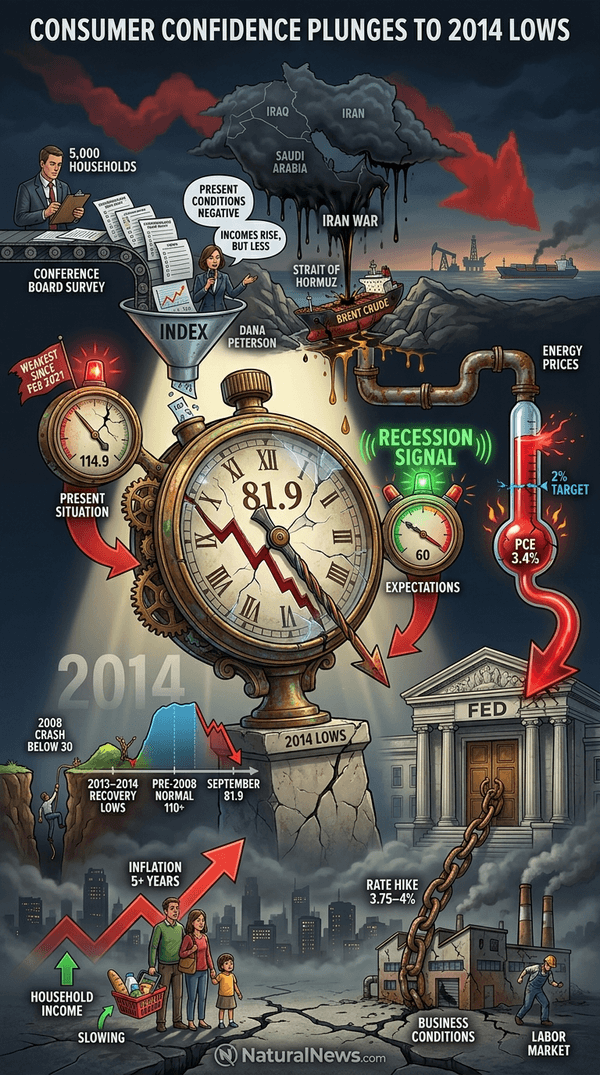
The Conference Board reported Tuesday, Sept. 29, that its consumer confidence index fell to 81.9 in September, down 6.7 points from August.
The reading is the lowest since 2014, when sentiment was rebounding from below 30 during the financial crisis, the board’s report stated. The decline marks the third consecutive monthly drop in the index, which measures Americans’ attitudes toward current economic conditions and their expectations for the next six months.
The Conference Board, a nonprofit business research group, compiles the index from a monthly survey of 5,000 households. “Consumer confidence dropped further in September, reflecting growing concerns about the economic outlook,” the report said. The September reading is well below the 100 level that prevailed before the 2008 financial crisis, when the index regularly topped 110.
Expectations Index and Historical Comparison
The expectations index, a six-month outlook, declined 3.2 points in September to nearly 60, the Conference Board said. That metric fell below 60 last year for the first time since 2013, according to the report.
The present situation index, which gauges consumers’ views of current business and labor conditions, also declined in September. “The Present Situation index fell to 114.9 (below 117.5 exp) – its weakest since Feb 2021,” according to ZeroHedge, which cited the survey results.
Historically, readings below 60 on the expectations index have signaled a forthcoming recession. The last time the index registered below 60 was in 2013, during the slow recovery from the Great Recession [1].
Labor Market and Business Conditions
Dana Peterson, the Conference Board’s chief economist, said consumer appraisals of present business conditions were negative in September for the first time in two years. “Perceptions of the current labor market also worsened, though remained within positive territory,” Peterson said in the release.
“Over the next six months, consumers expected both business conditions and the labor market to weaken,” she added. “Consumers still anticipated their household incomes to rise, but less so compared to previous months.”
In August, the Conference Board’s measure of consumer confidence had already fallen from a revised-lower 90.2 to 89.4, the lowest since January, according to ZeroHedge. The report noted that “Expectations plunge to January lows while Present Situation spiked from 5 year lows” [2].
The August decline was the second consecutive monthly drop, with Peterson stating at the time: “Consumer confidence moderated slightly in August for a second consecutive month” [2].
Inflation, Federal Reserve Policy and Middle East Conflict
Annual inflation has remained above the Federal Reserve’s 2% target for more than five years and has risen this year amid the Iran war, according to the report. The Middle Eastern conflict, which hit the seven-month mark Monday, has caused energy price spikes due to Iran’s restrictions on shipping in the Strait of Hormuz, officials said.
Fed officials do not expect personal consumption expenditures (PCE) inflation to fall to 2% until 2029, according to the median estimate in the central bank’s latest projections. PCE inflation was 3.4% in August and 3% excluding food and energy, according to Bureau of Economic Analysis data.
The Federal Open Market Committee (FOMC) raised rates by a quarter point to 3.75% to 4% earlier this month. The rate hike came as inflation pressures persisted, with the central bank signaling that further increases may be needed. According to ZeroHedge, “Rate-hike odds soar despite lowest core consumer price inflation since 2021” [3].
The Iran conflict, which began in February, has roiled global energy markets. In April, ZeroHedge reported that “Brent crude dropped back under $100 a barrel, and bond yields and rate hike odds – which track the price of oil one to one – halted their ascent” [4].
Second Confidence Measure and Political Context
The University of Michigan Surveys of Consumers index fell to 48.1 last month, down 7 percentage points from September 2025, according to the survey. The University of Michigan’s preliminary August Consumer Sentiment Index fell by almost 8% to 51 – from 55.2 in July – after two consecutive months of improvement, according to NTD [5].
The FOMC’s unanimous rate hike came after U.S. President Donald Trump urged officials to cut rates, and elevated inflation amid the unpopular Iran conflict has made life difficult for GOP lawmakers seeking to maintain control of Congress in November, according to the report. Economists have warned that the combination of high inflation, rising interest rates and geopolitical instability could push the U.S. economy into recession.
In March, ZeroHedge noted that “Recession fears surpass inflation concerns” as oil surged and bond yields fell [6]. The Conference Board’s Leading Economic Index has shown a significant drawdown of 17.8% as of the July reading [7].
References
- Conference Board Survey Signals Ugly Job Market, Weakest ‘Present Situation’ In Over 5 Years. ZeroHedge. July 28, 2026.
- New Home Sales Collapsed In July As Consumer Confidence Hit 7-Month Lows. ZeroHedge. August 25, 2026.
- Rate-Hike Odds Soar Despite Lowest Core Consumer Price Inflation Since 2021. ZeroHedge. September 11, 2026.
- Futures Rebound As Brent Dips Below $100. ZeroHedge. July 24, 2026.
- US Consumer Sentiment Sinks in August After 2-Month Rebound: UMich. NTD. August 14, 2026.
- Futures, Gold Jump As Yields Fall Despite Surging Oil As Recession Fears Surpass Inflation Concerns. ZeroHedge. March 30, 2026.
- Chris Martenson. Overvalued Equities Are Ignoring These Seven Recession Indicators. PeakProsperity.com. August 24, 2025.
- Key Events This Week: Jobs, Core PCE And ISM. ZeroHedge. September 28, 2026.
Explainer Infographic
Submit a correction >>
Tagged Under:
bubble, Conference Board, consumer confidence, debt bomb, debt collapse, economic collapse, economic outlook, economic recession, economic riot, Federal Open Market Committee, Federal Reserve, finance, finance riot, Inflation, interest rates, labor market, market crash, rate hikes, risk, unemployment
This article may contain statements that reflect the opinion of the author
RECENT NEWS & ARTICLES